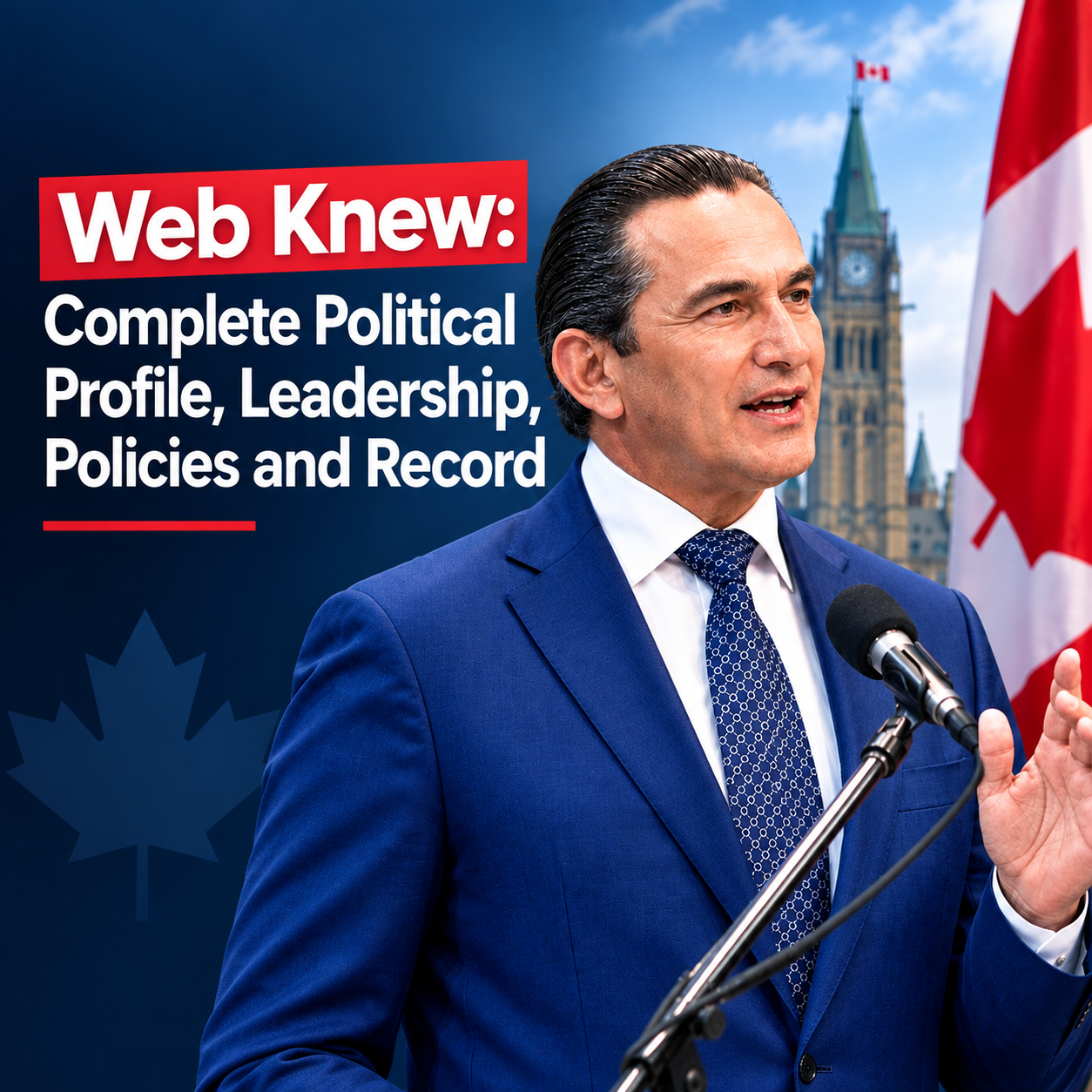
Web Knew
Introduction
Web Knew is one of the most important and historically significant figures in Manitoba politics. In October 2023, he became Manitoba’s 25th Premier and made history as the province’s first Nations Premier.
His political journey includes an education in economics and Indigenous governance, experience in broadcasting and media, entering electoral politics in 2016, becoming Manitoba NDP leader in 2017, and leading the party to victory in the 2023 provincial election.
As Premier, Knew has made healthcare, affordability, housing, jobs, public safety and Indigenous reconciliation key priorities for his government.However, Kane’s leadership cannot be judged only by his election victory or personal popularity.
The more important questions are whether he has delivered on his promises, whether healthcare and housing have actually improved, whether Manitobans are finding life more affordable, and how effectively his government has addressed crime, homelessness and economic challenges.
This report examines Kane’s personal background, political career, election performance, public opinion, family life, leadership strengths and weaknesses, and government policies to answer one central question: Is Web Knew delivering the government he promised Manitobans?
Provincial Politics:
What is Provincial Politics?
Provincial politics is the system through which a Canadian province makes decisions about matters that fall mainly under provincial jurisdiction. In Manitoba, this includes healthcare, education, many housing programs, labor rules, provincial infrastructure, municipalities and other important public services.
What does a Provincial Government do?
A provincial government creates and enforces provincial laws, prepares the provincial budget, raises revenue and funds major public services. Its decisions directly affect hospitals, schools, roads, housing programs, employment policies and many aspects of daily life.
How does Provincial Politics affect ordinary people’s lives?
Provincial politics affects ordinary people through the services they use every day. A decision made at the Manitoba legislature can influence whether someone can find a family doctor, how much funding a school receives, how quickly a hospital treats patients, how much affordable housing is available and how the province responds to homelessness and crime.
How does the Provincial Government affect healthcare?
Provincial governments are primarily responsible for administering publicly funded healthcare. Manitoba’s government funds hospitals, healthcare workers, doctors, nurses, emergency services, home care and other health programs. This makes healthcare one of the most important measures by which Manitobans judge their provincial government.
How does the Provincial Government affect education?
The province establishes major education policies, provides funding to school divisions, sets curriculum requirements and regulates the education system. Provincial decisions can therefore affect classroom resources, teacher recruitment, school construction and the quality of education available to students.
What role does the Provincial Government play in jobs and the economy?
The provincial government influences employment and economic growth through infrastructure spending, taxation, workforce training, business regulation, investment programs and economic-development policies. However, it does not control every part of the economy because interest rates, international trade and many other economic factors fall under federal or global influences.
How does the Provincial Government affect housing and the cost of living?
A provincial government can influence housing through affordable-housing programs, rental policies, building regulations, infrastructure, taxation and support for new construction. It can also introduce measures designed to reduce household expenses, although food prices, interest rates and global inflation are influenced by factors beyond provincial control.
What is the difference between the Federal Government and the Provincial Government?
The federal government deals mainly with national responsibilities such as defense, foreign affairs, federal taxation, immigration and criminal law. Provincial governments are primarily responsible for areas such as healthcare, education, provincial highways, labor regulation, municipalities and many social programs.
Why are Provincial Elections important?
Provincial elections determine which political party will control these major services. A federal election cannot directly decide who manages Manitoba’s hospitals or schools. A provincial election can determine the government responsible for them.
How can people evaluate the performance of a Provincial Government?
People should compare election promises with measurable results. Important indicators include healthcare wait times, doctor and nurse numbers, housing construction, homelessness, employment, education outcomes, crime statistics, taxation, government spending, debt and independent audits.
What is the difference between Provincial Politics and Federal Politics?
The main difference is jurisdiction. Federal politics focuses on issues affecting Canada as a whole, while provincial politics focuses largely on matters within a particular province. For Manitobans, this distinction is important because many of the services they use every day are controlled or funded by the provincial government.
Background & Personal Life:
Who is Web Knew beyond his position as Premier?
Web Knew is more than the Premier of Manitoba. He is a politician, author, former broadcaster, university administrator and musician. His unusual career before politics helped shape his public communication style and political identity.
What is Web Kane’s political and personal background?
Knew was born in Kenova, Ontario, and grew up partly in Winnipeg. He is from Nongaming First Nation. His background combines Indigenous identity, economics, Indigenous governance, media and public service.
Where was he born, and where did he grow up?
Web Knew was born in Kenova, Ontario, on December 31, 1981. He later grew up in Winnipeg. His family background and experiences in Manitoba became important parts of his later political identity.
How did his early life shape his political views?
His early experiences helped shape his views on Indigenous issues, education, social opportunity and reconciliation. His personal experiences also influenced the way he talks about overcoming difficulties and creating opportunities for others.
What influence did his parents have on his personality and values?
His parents were highly educated professionals. His father, Tobasonakwut Knew, was an academic, and his family environment exposed him to education, Indigenous governance and public affairs. These influences became important elements of Kane’s political worldview.
What are Web Kane’s educational qualifications?
Knew earned a Bachelor of Arts in Economics from the University of Manitoba and later completed a master’s degree in Indigenous governance.
Why did he study Economics and Indigenous Governance?
Economics gave him an understanding of markets, public finances and economic policy, while Indigenous governance connected his education with Indigenous political institutions, leadership and governance.
What did he do professionally before entering politics?
Before politics, Knew worked in broadcasting and media, served in university administration and had a career as a writer and musician.
How did his broadcasting and media experience shape his political communication?
Broadcasting taught him how to communicate complicated subjects to a general audience, answer difficult questions and remain composed during interviews. This became one of his strongest political skills.
What major life experiences influenced his political career?
His Indigenous background, education, media career, personal struggles and later transformation all contributed to the public figure he became. His willingness to discuss difficult parts of his past has also been a significant part of his political story.
Family & Personal Life:
Web Knew is married to Dr. Lisa Monk man, a physician. The couple live in Winnipeg and are raising their family together as a blended family.
Kane’s family background has also played an important role in shaping his public identity and political outlook.
Father Tobasonakwut Knew:
Web Kane’s father, Tobasonakwut Knew, was an Anishinaabe leader, professor and Indigenous governance scholar. He served as a regional Indigenous leader and taught Indigenous governance at the University of Winnipeg. He was also a survivor of Canada’s residential school system.
Mother Dr. Kathy Avery Knew:
His mother, Dr. Kathy Avery Knew, has worked as a policy analyst and academic. His parents’ professional and community backgrounds exposed Knew to Indigenous governance, education, public policy and social issues from an early age.
Wife Dr. Lisa Monk man
Knew is married to Dr. Lisa Monk man, who works as a physician, including in family and emergency medicine. Her medical career provides a connection to issues that are central to provincial politics, particularly healthcare, hospitals, access to doctors and support for families.
Children
Knew and Monk man are raising children together as a blended family in Winnipeg. Knew generally keeps details about his children’s private lives away from the political spotlight.
For a reporter-level profile, it is therefore more appropriate to focus on how family life and his parents’ experiences have influenced Kane’s public priorities rather than speculating about his children’s private lives.
Why His Family Background Matters Politically
Kane’s family history helps explain several themes that have remained important throughout his political career, including Indigenous issues, education, healthcare, social policy and reconciliation.
His father’s experience as a residential school survivor and Indigenous leader, combined with his mother’s academic and policy background, gave Knew exposure to both Indigenous community issues and public policy at an early age.
Tara Hart and Web Knew detail:
Tara Hart has been mentioned in connection with Web Kane’s personal history, particularly in relation to a past relationship and a domestic-violence case from 2003. According to the information you provided, Hart and Knew were in a relationship while they were university students.
Relationship with Web Knew
According to media reports, Tara Hart and Web Knew became involved while they were attending university. The two were reportedly in a relationship for approximately two years and lived together in an apartment during 2003.
Their relationship later ended, but their past relationship became a subject of renewed media attention years later.
The 2003 Domestic-Dispute Case
In 2003, following a domestic dispute, Tara Hart accused Web Knew of domestic assault. Police subsequently laid charges against Knew in connection with the incident. However, the charges were stayed by the court in 2004.
The Positions of Both Sides
The two sides have maintained different accounts of what happened. Tara Hart stood by her allegations and later spoke to the media about the incident. Web Knew, however, denied the allegations and said that, according to his account, the incident did not occur.
Renewed Media Attention in 2017
The issue received renewed attention in 2017, when Web Knew was becoming a prominent figure in Canadian politics. Canadian media revisited the allegations as part of reporting on Kane’s past and his political career.
For accurate and balanced reporting, it is important to distinguish between an allegation and a proven criminal offence. Tara Hart made the allegation, Web Knew denied it, and the charges were stayed in 2004. These points should therefore be presented separately when discussing the controversy.

Dr. Lisa Monk man:
Dr. Lisa Monk man is the wife of Manitoba Premier Web Knew. She is a highly educated physician and has built a professional career in medicine, Indigenous health and healthcare leadership. Her work extends beyond her role as the wife of a political leader, particularly through her involvement in healthcare and Indigenous communities.
Personal and Family Background
• Indigenous Background: Dr. Lisa Monk man is associated with the Anishinaabe/Ojibwa community and Lake Manitoba First Nation. She was born and raised in Winnipeg.
• Marriage: She married Web Knew in September 2016.
• Children: Lisa Monk man is the mother of three boys in the family. Her biological son is Tobasonakwut Knew, who was born in May 2017. She is also the stepmother of Web Kane’s two older sons from his previous relationship, Bash and Dominik Knew.
Medical Career
Dr. Monk man is a family physician and has pursued a professional career focused on healthcare and Indigenous health. She received her medical education from the University of Manitoba.
Her work has included providing healthcare services to underserved and Indigenous communities in Manitoba. According to the sources provided, she has worked in communities such as the Broken head Ojibwa Nation, helping provide primary healthcare services to local residents
Academic and Healthcare Leadership
In addition to her clinical work, Dr. Monk man has been involved in medical education and Indigenous health. She has served as a co-lead for the Indigenous Health Curriculum at the University of Manitoba at the postgraduate level.
Her professional work has also focused on addressing racism in healthcare and promoting greater equity within Canada’s healthcare system.
Dr. Monk man has served as an elected member of the College of Physicians & Surgeons of Manitoba (CPSM) Council and has chaired its Truth and Reconciliation Commission (TRC) Advisory Committee. She has also been a founding member and director of the Indigenous Physicians Association of Canada (IPAC).
Role in Web Kane’s Political Life
Dr. Lisa Monk man has also been visible during her husband’s political career. During the 2023 Manitoba election campaign, she publicly supported Web Knew and spoke about issues affecting healthcare workers and doctors.
As a physician and healthcare professional, her public involvement gave her perspective on Manitoba’s healthcare system particular relevance during the campaign. Her support also contributed to the public image of Kane’s family as he campaigned to lead Manitoba.
Overall, Dr. Lisa Monk man has a professional identity of her own, particularly in family medicine, Indigenous health, medical education and healthcare leadership, while also playing a visible role as Web Kane’s wife and a member of his family.

Web Kane’s Children:
Web Knew has three sons. His two older sons, Dominik Knew and Bash Knew, are from his previous relationship with Tara Hart (Tara Spence), while his youngest son, Tobasonakwut Kinew, is from his marriage to Dr. Lisa Monk man.
Dominik Knew
• Date of Birth: April 9, 2005.
• Mother: Tara Hart (Tara Spence).
• Background: Dominik is Web Kane’s eldest son. He has grown into a young adult. His name reflects a connection between his family’s Indigenous heritage and contemporary life.
• Cultural Role: According to the sources provided, Dominik has maintained a connection with his family’s traditions. As the eldest brother, he has also been described in the context of family life and the transmission of Anishinaabe traditions to younger generations.

Bezhigomiigwaan “Bash” Knew
• Date of Birth: Approximately 2006 or 2007, according to the information provided.
• Mother: Tara Hart (Tara Spence).
• Name: His traditional name is Bezhigomiigwaan, commonly shortened to “Bash.”
• Cultural Background: Web Knew has written about raising his older sons with an awareness of their Indigenous heritage. According to the sources provided, Dominik and Bash were introduced from a young age to cultural ceremonies, powwows and the Ojibwa language. Family activities, including sports and hockey, have also been part of their childhood experiences.

Tobasonakwut Knew
• Date of Birth: May 2017.
• Mother: Dr. Lisa Monk man, Web Kane’s wife.
• Name and Family History: Tobasonakwut was named after Web Kane’s late father, Tobasonakwut Knew, who was a respected Indigenous leader, chief and university professor. According to the information provided, the name comes from Ojibwa and refers to a cloud flying low near the earth.
• Public Appearances: Tobasonakwut has occasionally appeared with his parents at public events and cultural occasions. He has also been part of the family’s public image during Web Kane’s political career and his rise to become Manitoba’s first Nations premier.
•
Quick Reference Summary
Son Mother Birth Key Information
Dominik Knew Tara Hart 2005 Web Kane’s eldest son; connected to the family’s Indigenous traditions
Bash Knew Tara Hart 2006/2007 Traditional name: “Bezhigomiigwaan”; raised with Indigenous cultural traditions
Tobasonakwut Knew Dr. Lisa Monk man 2017 Named after his grandfather, Tobasonakwut Knew; his name refers to a low-flying cloud
Family and Privacy
Although Web Kane’s children have occasionally appeared in public discussions about his family and cultural background, information about their private lives remains limited. For a reporter-level profile, it is therefore more appropriate to focus on publicly documented family history, cultural heritage and their father’s public comments rather than speculate about their personal lives.

Political Career:
When did Web Knew enter electoral politics?
Knew entered Manitoba electoral politics in 2016 when he won the Fort Rouge constituency.
Why did he decide to enter politics?
Knew wanted to use public service to influence government policy and address issues affecting Manitoba communities. His transition from broadcasting to politics represented a major change in his professional life.
When was he first elected as an MLA?
He was first elected as the MLA for Fort Rouge in 2016.
How significant was his first victory in Fort Rouge?
The victory established Knew as a serious political figure and gave the Manitoba NDP a high profile new politician who could communicate effectively with the public.
Why was he chosen as Manitoba NDP leader in 2017?
Knew won the Manitoba NDP leadership in 2017. His public profile, communication skills and political potential made him an important figure for a party looking to rebuild.
How effective was he as Leader of the Opposition?
His record was mixed but ultimately politically successful. He could not defeat the Progressive Conservatives in 2019, but he maintained the NDP as the principal opposition party and later led it to government.
What political lessons did he learn from the 2019 election?
The 2019 result demonstrated that the NDP needed to broaden its appeal. The party had to address issues that mattered to a wider range of Manitobans, particularly healthcare, affordability, infrastructure and public services.
How did he rebuild the NDP after the 2019 election?
Knew and the NDP increasingly focused on practical household concerns rather than relying only on traditional ideological issues. Healthcare, affordability, housing and public services became central parts of the party’s message.
What were the main reasons behind the NDP’s 2023 election victory?
Healthcare dissatisfaction, affordability concerns, desire for political change, the NDP’s broader appeal and Kane’s personal popularity all contributed to the victory.
How important was Kane’s personal popularity to the NDP victory?
His personal popularity was highly important. His communication style and ability to connect with voters helped the NDP present itself as a credible alternative to the Progressive Conservatives.
What were his major election promises?
Major promises included improving healthcare staffing and access, addressing affordability, increasing housing supply, tackling homelessness, improving public safety and supporting economic development.
How many of those promises have been fulfilled?
There is no universally accepted single percentage for promise completion. Some commitments have been substantially advanced, while others remain works in progress. A responsible assessment should examine each promise individually.
Which major promises remain unfulfilled?
Healthcare pressure, homelessness, housing affordability, public safety concerns and fiscal challenges remain major areas where the government has not completely achieved the transformation promised during the campaign.
What has been the biggest challenge of his political career?
His biggest challenge has been converting political popularity and government spending into measurable improvements in complex systems such as healthcare, housing and public safety.
Has his political career developed as he originally expected?
His career has taken an unusual path. Moving from broadcasting and music into provincial politics and eventually becoming Manitoba’s first Nations premier was not a conventional political trajectory.
Becoming Premier
How did Web Knew become Premier of Manitoba?
The Manitoba NDP won a majority government in the October 3, 2023 provincial election. Knew was subsequently sworn in as Manitoba’s 25th premier.
What was the biggest reason behind his 2023 election victory?
The strongest factors were healthcare concerns, affordability, dissatisfaction with the previous government and Kane’s personal appeal.
Why was his victory historically significant for Manitoba?
Knew became Manitoba’s first Nations premier. His election represented a major milestone in the province’s political history.
How important was his Indigenous identity during the election campaign?
His Indigenous identity was historically significant and helped distinguish him as a political leader, but it should not be treated as the sole reason for his victory. Healthcare, affordability, leadership and desire for change were also major factors.
Did voters support Knew because of his policies or because they wanted a change in government?
Both factors mattered. Some voters supported specific NDP policies, while others were primarily motivated by dissatisfaction with the Progressive Conservative government.
What were his first priorities after becoming Premier?
Healthcare, affordability, housing, reconciliation, public safety and economic development became important priorities for his government.
What were his first major decisions?
His government moved quickly to emphasize healthcare recruitment, affordability measures, housing programs and changes in public policy related to Indigenous relations and public services.
What major problems did he inherit from the previous government?
He inherited healthcare staffing shortages, pressure on emergency departments, affordability concerns, housing shortages, homelessness, public-safety challenges and fiscal pressures.
How many of those problems has his government actually addressed?
There has been measurable progress in several areas, particularly healthcare recruitment and housing investment, but the major challenges have not been completely resolved.
Which major problems remain unresolved?
Healthcare access, homelessness, housing affordability, public safety, addictions and government finances remain significant challenges.
Has Knew delivered the change he promised before the election?
He has delivered some significant changes and investments, but the complete transformation promised during the 2023 campaign has not yet been achieved.
Elections & Voting Ratio:
What percentage of the provincial vote did the Manitoba NDP receive in 2023?
The Manitoba NDP received approximately 45.3% of the provincial vote in the 2023 election.
How many seats did the NDP win in 2023?
The NDP won 34 of Manitoba’s 57 seats, giving it a majority government.
How many votes did Web Knew receive in Fort Rouge?
Knew received 9,620 votes in Fort Rouge in the 2023 election.
What was his personal vote share?
His vote share was approximately 70%, substantially higher than the NDP’s province-wide vote share.
What was his winning margin?
He won Fort Rouge by approximately 5,195 votes.
How different was his personal vote share from the NDP’s province-wide vote share?
The difference was substantial. Kane’s approximately 70% constituency result was roughly 25 percentage points higher than the NDP’s 45.3% province-wide result.
How did the 2023 results compare with 2019?
The improvement was dramatic. In 2019, the NDP won 18 seats and approximately 31.3% of the vote. In 2023, it won 34 seats and approximately 45.3%.
Was the NDP’s success concentrated in Winnipeg or did it expand across Manitoba?
Winnipeg was central to the NDP victory, but the party also made gains beyond the city. Its 2023 victory therefore represented a broader coalition than the party had achieved in 2019.
Which voter groups were most important to Kane’s victory?
Urban voters, healthcare-focused voters, younger voters, Indigenous communities, progressive voters and people seeking political change all contributed to the coalition.
Which parts of Manitoba remain difficult territory for the NDP?
Several rural and southern Manitoba constituencies remain difficult territory because the Progressive Conservatives continue to have strong support in many rural communities.
Is Knew personally more popular than his political party?
Available polling strongly suggests that his personal approval can be higher than the NDP’s voting intention. This means some Manitobans may have a positive view of Kinew even when they do not necessarily support every NDP policy.
Could voters support Knew personally but choose not to vote for the NDP?
Yes. Leadership approval and voting intention measure different things. A voter can approve of a premier’s personal performance while preferring another party on election day.
What issues could determine the next provincial election?
Healthcare, affordability, housing, homelessness, crime, jobs, taxation, government finances and rural development could all influence the next election.
Can Knew maintain his current voter coalition?
That will depend on whether his government can maintain strong support in Winnipeg while improving its position among rural voters and demonstrating visible results in healthcare, housing and affordability.
Public Opinion:
What do ordinary Manitobans really think about Web Knew?
Overall, polling indicates relatively strong personal support for Knew. However, public opinion about him should be separated from opinions about individual government policies.
Why do people support him?
Supporters often point to his communication skills, personal story, healthcare investments, affordability measures and historic role as Manitoba’s first Nations premier.
Why do people oppose him?
Critics commonly raise concerns about healthcare performance, homelessness, crime, government spending, deficits and whether the government’s policies are producing enough measurable results.
Do Manitobans consider him trustworthy?
His strong approval ratings indicate substantial public confidence, although approval should not automatically be interpreted as universal trust.
Do voters consider him an effective Premier?
A significant share of Manitobans clearly view him positively, but opinions about individual policies and government performance remain mixed.
Has his popularity increased or decreased since becoming Premier?
His approval has fluctuated rather than moving in one direction. Angus Reid reported 68% approval in June 2025, 58% in December 2025 and 62% in June 2026.
Which policies have increased his popularity?
Healthcare recruitment, affordability measures, housing investment and public-service improvements have helped strengthen his government’s public image.
Which policies have damaged his popularity?
Concerns around crime, homelessness, affordability, healthcare waits and government finances have created political pressure.
What are the three biggest public complaints about his government?
The most important recurring concerns are healthcare access, cost-of-living pressure and homelessness/public safety.
What are the three strongest reasons people support his government?
Healthcare investment, Kane’s personal leadership and the perception that his government represents political change are three major reasons.
Winnipeg remains the NDP’s strongest political base, and Knew has maintained substantial support in the city.
How do rural Manitobans view his leadership?
Rural opinion is more mixed. The Progressive Conservatives remain competitive or dominant in many rural areas.
How do Indigenous communities view his government?
Views are diverse. Some Indigenous leaders welcome his historic leadership and policy direction, while others continue to demand faster progress on reconciliation, housing, infrastructure and economic issues.
How does the business community view his policies?
Business opinion is mixed. Some businesses welcome infrastructure and investment, while others remain concerned about taxation, regulation, labor costs and government spending.
What reliable polling or independent evidence exists about public satisfaction with his government?
Angus Reid and Probe Research provide useful independent polling. Official election data from Elections Manitoba, government statistics, Statistics Canada and reports from independent oversight bodies provide additional evidence for evaluating his government’s performance.
Leadership Strengths & Weaknesses:
What is Web Kane’s greatest leadership strength?
His strongest leadership asset is arguably his ability to communicate and connect with voters.
Is he an effective public speaker?
Yes. His broadcasting experience has given him strong interview and public-speaking skills.
Is he better at campaigning or governing?
His campaigning and communication abilities are already well demonstrated. His governing record remains more difficult to judge because many of the systems he is trying to change require several years to produce results.
How effectively does he handle political pressure?
He has generally maintained a composed public image and relatively strong approval despite significant political challenges.
How effective is his communication during a crisis?
His media experience gives him an advantage when communicating during difficult situations. However, effective communication must ultimately be matched by effective action.
Does he genuinely listen to criticism?
The government has changed or adjusted policies in response to political andpublic pressure, although opposition parties often argue that the response is not fast enough.
Does he accept responsibility when his government makes mistakes?
Knew has acknowledged problems in areas such as healthcare, but critics argue that his government sometimes emphasizes inherited problems rather than accepting full responsibility for current conditions.
Is he willing to change policies when evidence changes?
There have been policy adjustments during his time in office, although determining whether these changes are sufficiently evidence-based requires examining individual policies.
Has he built a strong cabinet team?
His cabinet includes experienced politicians and representatives from different parts of Manitoba. Its overall effectiveness should be assessed by individual ministry performance.
How effective has his cabinet been overall?
The record is mixed. Some departments have produced visible initiatives, while healthcare, housing and public safety remain areas of continuing pressure.
What is Kane’s biggest political weakness?
His biggest weakness may be the gap between high public expectations and the slow pace of solving complex provincial problems.
What is the strongest criticism of his leadership?
The strongest criticism is that government announcements and spending have not always translated quickly enough into visible improvements for ordinary Manitobans.
Has he made any major political mistakes as Premier?
The most important political risk has been promising rapid transformation in systems that naturally take years to repair.
Did his government make too many promises during the election?
The 2023 campaign contained an ambitious agenda, particularly regarding healthcare and affordability. The challenge has been delivering those commitments while managing fiscal constraints.
Is his government delivering fewer results than it promised?
The answer varies by policy. There is clear progress in some areas, but several major promises remain incomplete.
Wife, Children & Family
Who is Web Kane’s wife?
Web Knew is married to Dr. Lisa Monk man, a physician.
What publicly available information exists about Lisa Monk man?
She is a physician and has worked in family medicine. She has also appeared publicly in connection with Kane’s political career and healthcare issues.
What is Lisa Monk man’s professional background?
She is a medical doctor with experience in family medicine, including work connected to inner-city healthcare.
Has Lisa Monk man publicly discussed Web Kane’s political career?
She has appeared publicly with Kinew and has participated in public discussions and campaign-related activities, particularly around healthcare.
What has Web Knew publicly said about his wife?
Knew has spoken publicly about his family and has described his wife as an important part of his personal life.
How many children does Web Knew have?
Knew and Monk man have three sons.
What information about his children is publicly available?
Some information and names have appeared in credible public reporting and Kinney’s own public discussions. However, their privacy should be protected.
How should the names of his children be reported if they are confirmed by credible public sources?
Names should only be included when there is a legitimate journalistic reason and the information has been responsibly published. Children’s private information should not be unnecessarily publicized.
What has Knew said publicly about fatherhood?
He has spoken about the importance of being a father and has connected family life with his broader views about the future of Manitoba.
How has being a father influenced his political priorities?
His public comments suggest that children and future generations are part of his motivation on issues such as healthcare, education, affordability and opportunity.
What have his family members publicly said about his leadership or personality?
Public comments from family members have generally portrayed him as committed to his family and serious about public service.
How have the responsibilities of being Premier affected his family life?
The premiership involves long hours, travel, security arrangements and constant public attention, all of which can place additional demands on family life.
Has his wife or family publicly supported his political career?
Yes. His wife has appeared publicly with him during political and healthcare-related activities.
What privacy boundaries should journalists respect when reporting about his children?
Journalists should avoid publishing private information such as children’s locations, schools, routines, friends or other details that could compromise their privacy or safety.
Health & Personal Well-Being:
What health information has Web Knew publicly disclosed?
Only publicly confirmed information should be used when discussing his personal health. His current private medical condition should not be speculated about.
Has he personally discussed any significant health issues?
Knew has publicly discussed difficult experiences from his younger years and personal transformation. These discussions should not be confused with claims about a current medical condition.
Has he publicly discussed fitness or wellness?
He has discussed lifestyle changes and personal wellbeing in the context of his life story, but journalists should distinguish personal statements from medical information.
How does he manage the demanding workload of being Premier?
The precise details of his personal routine are private. The Premier’s Office, ministers and public-service officials share responsibility for managing the government’s workload.
How does he deal with stress and political pressure?
Publicly, Knew generally presents himself as calm and resilient. His media background also helps him manage high-pressure interviews and political criticism.
Is there any verified public information about the effects of his workload?
There is no responsible basis for making unsupported claims about his private health or the medical effects of his workload.
Has he spoken publicly about mental health or personal resilience?
His public life story contains significant discussion of resilience, personal change and overcoming difficult experiences.
What should journalists verify before reporting on a politician’s health?
Journalists should rely on direct statements, official announcements or credible reporting. They should never diagnose a politician based on photographs, rumors or social-media speculation.
Healthcare Performance:
What promises did Web Knew make about Manitoba’s healthcare system?
His government promised to recruit more doctors, nurses and other healthcare workers, improve primary-care access, expand healthcare capacity and reduce pressure on emergency departments.
Has healthcare actually improved under his government?
There has been measurable progress in healthcare staffing and access to family doctors, but serious system pressures remain. It is therefore more accurate to describe the record as progress rather than a completed healthcare transformation.
Have emergency-room wait times improved?
Emergency-room performance remains a major challenge. Some indicators have improved at different times, but Manitoba’s emergency departments continue to experience significant pressure.
Has access to family doctors improved?
There has been significant progress. Manitoba reported that by December 2025, 99% of Winnipeg residents using Family Doctor Finder were matched with a provider within 25 days.
Has the number of doctors and nurses increased?
The government has reported a substantial increase in healthcare workers since Kinew took office.
Has the healthcare workforce shortage decreased?
Recruitment has improved staffing levels, but shortages and retention pressures remain, particularly in some specialties and rural and northern communities.
How much has the Knew government spent on healthcare?
Healthcare spending has increased substantially under Kane’s government, with successive budgets providing additional funding to Manitoba’s health system.
Has increased healthcare spending produced measurable results?
Yes, particularly in workforce recruitment and primary-care access. However, spending alone does not prove that the entire healthcare system has improved.
What measurable healthcare targets has the government established?
Important indicators include healthcare-worker recruitment, family-doctor access, emergency-room wait times, surgical waits, hospital capacity and healthcare vacancies.
Are those targets being achieved?
Some targets and indicators are showing progress, while others remain challenging. The overall record is therefore mixed rather than uniformly successful.
What do healthcare workers think about his reforms?
Healthcare organizations have generally welcomed additional staffing and investment while continuing to raise concerns about workload, retention, working conditions and system capacity.
How do patients view his healthcare policies?
Patients are likely to judge the policies primarily through practical outcomes: access to doctors, waiting times, hospital care and availability of services.
What are the biggest unresolved problems in Manitoba healthcare?
Emergency-room pressure, rural and northern access, staffing retention, surgical waits and long-term healthcare capacity remain major challenges.
Cost of Living & Housing:
Has Manitoba become more affordable under Knew?
The answer is mixed. Government programs have provided relief in some areas, but many households continue to experience significant financial pressure.
What has his government done to reduce household costs?
The government has introduced affordability measures and invested in public services intended to reduce pressure on families.
What has happened to food affordability?
Food remains a major household concern. Provincial policies can provide some relief, but food prices are also affected by national and international inflation and supply-chain conditions.
What impact have his policies had on electricity and utility costs?
Provincial decisions can influence utility policy, particularly through Manitoba Hydro and regulation, but household utility costs must also be considered alongside broader energy and inflation trends.
What changes have occurred in taxes and government fees?
Kane’s government has introduced and adjusted several tax and affordability measures. The overall effect should be assessed by examining the complete household tax burden rather than one individual measure.
Are middle-class Manitobans financially better off today?
The evidence is mixed. Government programs may provide assistance, but independent polling indicates that many households continue to feel financially squeezed.
What evidence supports the government’s affordability claims?
The government points to tax measures, affordability programs, housing investment and other initiatives. Independent economic and polling data should be used to determine whether these measures have improved household finances.
What is Kane’s affordable-housing strategy?
The strategy includes social housing, affordable housing, repairs to Manitoba Housing, rental construction incentives and programs intended to increase the overall housing supply.
How many new housing units has the government helped build or support?
By February 2026, the province said it had committed funding for 1,640 social and affordable housing units. It also reported bringing more than 2,000 Manitoba Housing units back online through repairs and supporting thousands of additional rental units through construction incentives.
Has housing actually become more affordable?
Not enough to say the housing problem has been solved. More supply is important, but affordability also depends on rents, household income, interest rates and overall housing demand.
Has homelessness increased or decreased?
The situation remains serious, particularly in Winnipeg. Government investment has increased, but homelessness has not been eliminated.
What is the government doing about Winnipeg’s homelessness crisis?
The government is investing in transitional housing, supportive housing, homelessness programs and services for people facing addiction and other barriers to stable housing.
Crime, Public Safety & Addictions:
Has crime increased or decreased under Knew?
Crime statistics vary by category and location. The government points to improvements in some areas, but crime remains a major public concern, particularly in Winnipeg.
What is the government doing to address violent crime?
The government has increased attention to policing, public safety, repeat offenders, addictions and community interventions.
What is the government’s strategy for repeat offenders?
The approach combines policing and justice measures with interventions intended to address addiction and other factors contributing to repeated offending.
What measures are being taken to address the addictions crisis?
The government is using treatment, community services, harm-reduction measures, supportive housing and public-safety interventions.
What is Kane’s approach to the drug crisis?
His government has moved toward stronger intervention alongside treatment and support programs, particularly for people experiencing severe addictions-related crises.
Is Winnipeg safer today than before?
There are signs of improvement in some crime indicators, but the answer depends on the specific crime category. It would be misleading to describe Winnipeg simply as either “safe” or “unsafe.”
What do police organizations say about Kane’s public-safety policies?
Police organizations generally emphasize the need for adequate resources, staffing, effective justice measures and action on repeat offending and addictions.
How do victims’ organizations assess the government’s performance?
Victims’ advocates generally want stronger victim support, accountability, prevention and faster justice. Their priorities do not always perfectly match government priorities.
Has increased public-safety spending produced measurable results?
Some results can be measured through crime statistics and policing capacity, but spending alone does not prove success. Long-term results depend on policing, courts, addiction treatment, housing and social conditions.
Indigenous Leadership & Reconciliation:
What does becoming Manitoba’s first Nations Premier mean for Web Knew?
It is one of the most historically significant aspects of his political career. His election changed the symbolic representation of Manitoba’s provincial leadership.
How has his Indigenous identity influenced his government?
Indigenous relations and reconciliation have received significant attention. His government has also emphasized Indigenous communities, northern Manitoba and historical recognition.
What actions has his government taken on reconciliation?
The government has pursued initiatives related to Indigenous relations, historical recognition and reconciliation. One notable action was legislation recognizing Louis Riel as Manitoba’s first premier.
Have relations between the provincial government and Indigenous communities improved?
There have been stronger formal efforts at engagement, but relations remain complex and cannot be described as uniformly improved.
Which reconciliation commitments have been fulfilled?
Some symbolic, legislative and policy commitments have moved forward, but broader reconciliation objectives remain ongoing.
Which commitments remain outstanding?
Major issues involving Indigenous housing, healthcare, child welfare, infrastructure, poverty and economic participation remain unresolved.
What do Indigenous leaders say about Kane’s performance?
There is no single Indigenous position. Some leaders welcome his historic leadership and policies, while others continue to criticize the pace or substance of government action.
Has his government also faced criticism from Indigenous communities?
Yes. Indigenous leadership is not the same as unanimous Indigenous political support. Kinew’s government has faced demands for stronger action from some Indigenous organizations and leaders.
Has there been measurable progress on reconciliation?
There has been measurable policy activity, but reconciliation is a long-term process that cannot be judged as complete during one political term.
Economy, Accountability & Future:
What is Web Kane’s economic vision for Manitoba?
Kane’s government emphasizes infrastructure investment, good jobs, healthcare, affordability, economic development, Indigenous participation and strategic investment in Manitoba’s economy.
Have employment and investment genuinely increased under his government?
Employment has grown during his time in office, while government investment has increased substantially. Private-sector investment should be assessed separately using independent economic data.
Is government spending providing taxpayers with good value for money?
That remains one of the most important accountability questions facing the government. Spending should be judged by outcomes, not simply by the amount of money announced or spent.
If Knew loses the next election, what is the most likely reason?
The most likely reasons would be failure to produce visible improvements in healthcare, affordability, housing or public safety, combined with concerns about government finances. A major decline in his personal popularity or a significant shift in rural Manitoba could also be decisive.
After examining his complete political record, is Web Knew delivering the government he promised Manitobans?
The most balanced answer is partially.
Knew has achieved important milestones and his government has produced measurable progress in several areas. Healthcare staffing has increased, family-doctor access has improved in important measures, housing investment has expanded and new programs have been introduced to address homelessness and public safety.
However, some of the problems that helped bring him to power remain unresolved.
Healthcare continues to face pressure. Housing affordability remains difficult. Homelessness is still a major challenge. Crime and addictions remain important public concerns. Government finances also remain an area of political debate.
Therefore, Kane’s record should not be described as either a complete success or a complete failure.
The stronger conclusion is that his government has made significant progress and introduced substantial changes, but it has not yet fully delivered the transformation promised to Manitobans in 2023.
Final Reporter Assessment
Web Kane’s political story is unusual. He moved from broadcasting and personal challenges into provincial politics, became leader of the Manitoba NDP, lost the 2019 election and then rebuilt the party into a majority government four years later.
His historic election as Manitoba’s first Nations premier is a major part of his legacy. But history alone will not determine whether his government is considered successful.
Ultimately, Manitobans will judge Knew on practical results.
Are hospital waits getting shorter?
Can people find family doctors?
Are homes becoming more affordable?
Is homelessness declining?
Are communities becoming safer?
Are families financially better off?
Is government spending producing measurable value?
These questions will determine whether Kane’s political popularity becomes a lasting governing legacy.
Final Verdict
Web Knew has clearly changed Manitoba’s political landscape, but his biggest challenge is turning political popularity and government investment into lasting improvements in the everyday lives of Manitobans.
Table of Contents

Leave a Reply