
Business & Economy
introduction
Canada’s business and economy in 2026 are shaped by a mix of economic recovery, changing interest rates, inflation pressures, employment trends, trade uncertainty, and opportunities for businesses and entrepreneurs. From GDP growth and consumer spending to the TSX, small-business financing, Canada–U.S. trade, and the growing startup and technology sectors, these developments have a direct impact on businesses, workers, investors, and households across the country.
This guide provides a clear overview of Canada’s Business & Economy landscape in 2026. It explores the latest economic growth and inflation trends, Bank of Canada interest rates, stock-market conditions, small-business opportunities, employment and wages, international trade, startups, venture capital, banking, household debt, saving, and investment. By understanding these key areas, readers can better understand the major economic forces shaping Canada and the financial environment Canadians are experiencing today.
what is Business & Economy
Business & Economy Canada refers to business and economic topics specifically related to Canada.
It may include:
- Canadian companies and industries
- Jobs, wages, and unemployment
- Inflation, interest rates, and the Canadian dollar
- Government budgets, taxes, and economic policies
- Trade with the United States and other countries
- Banking, investments, and Canadian financial markets
- Housing, energy, natural resources, and small businesses
How Is Canada’s Economic Growth and GDP Performing?
Canada’s economy strengthened in the second quarter of 2026 after very weak growth at the start of the year. Real GDP increased 0.8% quarter over quarter, while first-quarter growth was revised to 0.1%. The second-quarter increase was supported by exports, household spending and business capital investment. Exports rose 3.6%, their strongest quarterly increase in more than three years. However, trade uncertainty and excess economic capacity continue to affect the outlook.

What Is Canada’s Inflation Rate and How Are Consumer Prices Changing?
Canada’s annual inflation rate was 3.0% in August 2026, unchanged from July. Food purchased from stores increased 2.8%, while shelter prices rose 1.5% year over year. Transportation prices were 7.5% higher, with gasoline remaining an important influence on headline inflation. Excluding gasoline, CPI increased 2.4% in August. The Bank of Canada continues to monitor energy prices, tariffs and other cost pressures closely.
What Is the Bank of Canada Interest Rate?
The Bank of Canada held its overnight policy rate at 2.25% on September 2, 2026. The Bank Rate remained at 2.50%, while the deposit rate was 2.20%. The decision came as Canadian economic activity strengthened but inflation remained around 3%. The Bank also highlighted increased uncertainty from U.S. tariffs, Canadian counter-tariffs and elevated energy prices. The next scheduled rate announcement is October 28, 2026, when the Bank will also release its next Monetary Policy Report.
How Is Consumer Spending Performing in Canada?
Consumer spending increased 0.8% in the second quarter of 2026, helping support overall economic growth. Higher spending was recorded on passenger vehicles, rent and mutual funds and other investment services. At the same time, households purchased less gasoline and food, partly in response to higher prices. Household disposable income increased 2.1%, while the household saving rate reached 3.7%. The Bank of Canada expects consumption growth to remain relatively modest as households continue to face affordability pressures.
How Is Business Investment Performing in Canada?
Business investment strengthened in the second quarter of 2026 and was one of the contributors to Canada’s economic growth. Businesses increased investment in areas including medium and heavy trucks, communications equipment, and audio and video equipment. The Bank of Canada expects business investment to strengthen further during 2026, particularly in the oil and gas sector. Investment outside oil and gas is expected to improve later as businesses adjust to changing trade conditions. Trade uncertainty and tariffs remain important factors affecting business decisions.
What Is Canada’s Economic Outlook for 2026 and 2027?
The Bank of Canada projects real GDP growth of about 0.7% in 2026, followed by 1.8% in 2027 and 2028. The expected recovery is linked partly to stronger exports, business investment and government spending. Consumption is also expected to contribute, although household spending growth is projected to remain modest. Inflation is expected to move closer to the Bank’s 2% target in early 2027, but the outlook remains sensitive to oil prices, tariffs and geopolitical developments.
What Is the S&P/TSX Composite?
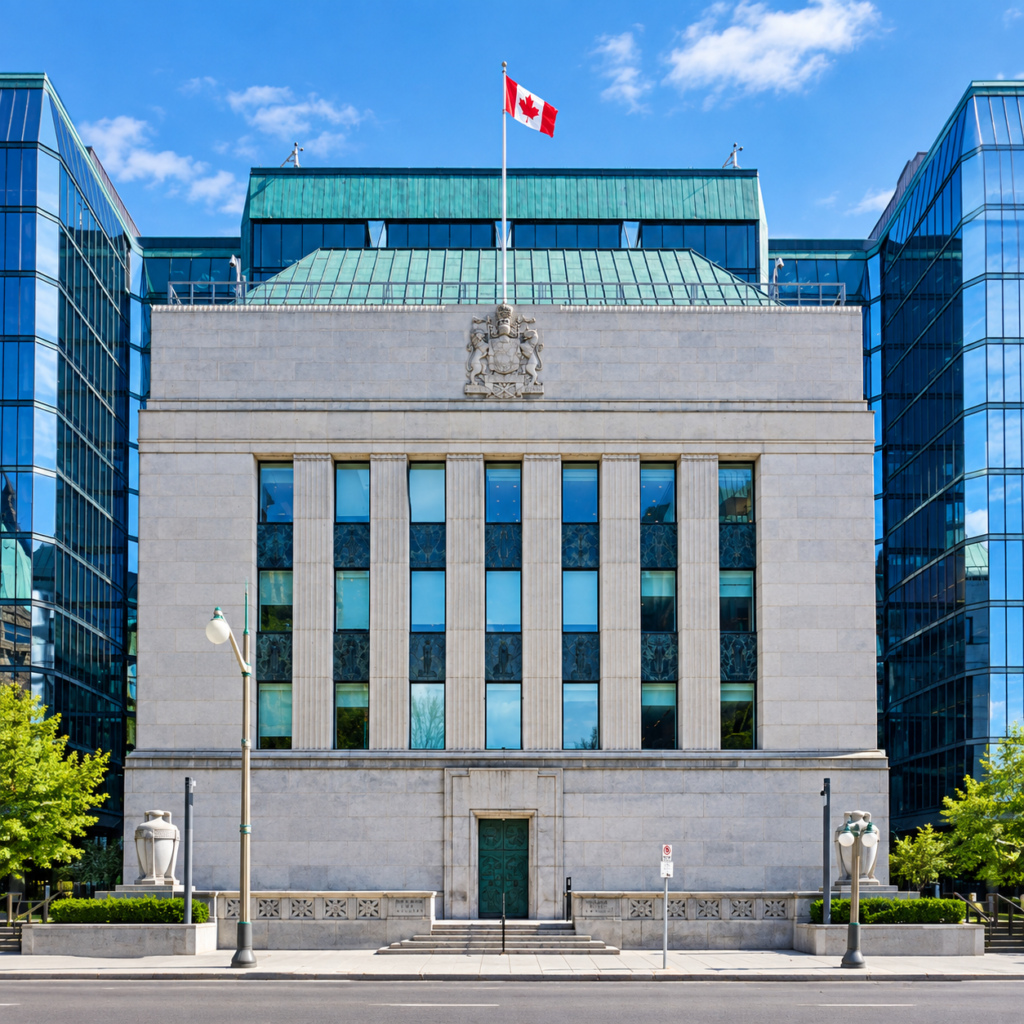
The S&P/TSX Composite Index is Canada’s main broad stock-market benchmark and tracks a large group of companies listed on the Toronto Stock Exchange. It covers major sectors including financials, energy, materials, industrials, technology and utilities. On September 30, 2026, the index closed at 35,235.87, down 224.40 points or 0.63%. The decline extended the index’s September weakness, with mining stocks among the areas weighing on the market.
What Are the Latest TSX Market Trends?
The TSX entered October after a difficult September, with investors watching interest rates, bond yields, commodity prices and Canada-U.S. trade developments. On September 30, the index fell 0.63% as weakness in mining and other sectors outweighed gains in energy stocks. Technology and some mining shares had shown strength during parts of the month, but the overall market remained sensitive to global economic developments. U.S. inflation data and movements in oil, gold and bond yields are also important influences on Canadian stocks.
What Are the Top Companies Listed on the TSX?
The TSX includes many of Canada’s largest publicly traded companies across banking, energy, mining, telecommunications, retail and technology. Major names include Royal Bank of Canada, Toronto-Dominion Bank, Enbridge, Canadian Natural Resources, Bank of Montreal, Canadian Imperial Bank of Commerce and Shopify. Their size and sector exposure mean that movements in large companies can influence the broader index. The list of major constituents can change over time as companies grow, shrink or are rebalanced within the index.
How Are TSX Sectors Performing?
TSX sector performance can vary significantly because Canada’s market has substantial exposure to financial companies, energy producers and materials businesses. On September 30, weakness in mining and other sectors contributed to the index’s 0.63% decline, while energy stocks provided some support. Financial stocks were also among the areas investors were watching amid changes in bond yields and interest-rate expectations. Because different sectors respond differently to commodities, rates and economic growth, the overall index can sometimes hide significant differences between industries.
Which Canadian Stocks Are the Latest Market Movers?
Daily TSX market movers can change quickly based on company announcements, commodity prices, earnings, economic data and investor sentiment. On September 30, Air Canada gained 2.8% following changes to its Aeroplan credit-card benefits, while WSP Global and MDA Space were among stocks that declined. Badger Infrastructure Solutions, Montage Gold, Torex Gold Resources and DPM Metals were also among notable gainers that day. These daily moves illustrate how individual companies can perform differently even when the broader index is falling.
What Is the TSX Outlook for October 2026?
The TSX enters October with investors closely watching Canadian economic data, U.S. inflation and employment figures, commodity prices, bond yields and Canada-U.S. trade developments. The September 30 decline showed continued sensitivity to global interest-rate and commodity-market conditions. Energy prices may remain important for Canadian resource companies, while higher bond yields can affect rate-sensitive sectors. Rather than pointing to a single market direction, current conditions suggest that investors are monitoring several competing economic and corporate factors going into the fourth quarter.
How Can You Start a Small Business in Canada?
Starting a small business in Canada generally begins with choosing a business idea, researching the market and preparing a business plan. You then choose a structure, such as a sole proprietorship, partnership or corporation, and register the business as required. You may also need a Business Number, tax accounts, permits and licences. The federal government’s startup guidance brings together information on planning, registration, permits, financing and tax obligations.
What Are the Main Costs of Running a Small Business in Canada?
Small-business costs can include registration, rent, equipment, inventory, insurance, employee wages, marketing, software, utilities and professional services. Tax expenses can also include income tax, GST/HST and payroll-related obligations, depending on the business. Costs vary considerably by industry, location and business structure. Keeping accurate financial records helps owners understand operating costs, manage cash flow and identify eligible business expenses.
What Taxes Do Small Businesses Pay in Canada?
Small businesses can have several tax responsibilities depending on how they operate and whether they are incorporated. Sole proprietors generally report business income or losses on their personal tax return, while corporations generally file a separate corporate income tax return. Businesses may also need to register for GST/HST and collect and remit it when registration requirements apply. Payroll deductions and other tax accounts may be required when a business has employees.
How Can Small Businesses Get Financing in Canada?
Canadian businesses can access financing through banks, credit unions, government programs and alternative lenders. Financing can include term loans, lines of credit, business credit cards and other products used for equipment, working capital or expansion. In 2023, 88.2% of SMEs that requested debt financing had their largest request fully or partially approved. The Canada Small Business Financing Program also helps participating financial institutions provide loans by sharing some lending risk with them.

What Government Support Is Available for Small Businesses?
The Canadian government provides different forms of support, including financing programs, grants, contributions, tax credits, advisory services and regional programs. The Business Benefits Finder can help businesses identify programs based on their location, sector and needs. Support is available for areas such as innovation, Indigenous businesses, agriculture, exports and business growth. Businesses affected by specific economic pressures can also use Canada’s business-support tools to find relevant financing and other programs.
How Can Small Businesses Grow in Canada?
Small-business growth can involve increasing sales, entering new markets, hiring employees, investing in technology or expanding production. Statistics Canada’s latest SME financing and growth survey found that 65.9% of SMEs reported average annual sales growth between 2021 and 2023, while 72.6% expected average yearly growth from 2024 to 2026. Businesses can use financing, government programs and professional advice to support expansion. Rising input costs, taxes and competition remain important challenges for many SMEs.
How Important Is Canada–U.S. Trade?
Canada and the United States have one of the world’s largest and most integrated trading relationships, with extensive cross-border supply chains in energy, automobiles, agriculture, manufacturing and other industries. The U.S. remains Canada’s largest export market, even as Canada works to expand trade with other countries. In 2025, Canadian goods trade with the U.S. weakened amid tariffs and trade-policy uncertainty. At the same time, exports to non-U.S. markets increased, raising their share of Canada’s total exports.
What Are Canadian Tariffs?
Canadian tariffs are duties or surtaxes placed on certain goods imported into Canada. In response to recent U.S. measures, Canada introduced counter-tariffs on selected American products, with rates of 15%, 25% and 50% depending on the product. From September 8, 2026, the measures covered about $27.6 billion worth of U.S. imports, including products such as steel, appliances, agricultural equipment, pulp and paper, plastics and electronics.
What U.S. Tariffs Are Being Applied to Canadian Goods?
The United States has imposed several tariff measures affecting Canadian exports. In August 2026, the U.S. introduced 50% Section 338 tariffs on a range of Canadian products, including plastics, furniture, electronics, paper, machinery, wood products, textiles and other goods. Unlike some earlier measures, these Section 338 tariffs do not generally exempt goods simply because they qualify for preferential treatment under CUSMA.
How Is Canada Diversifying Its Trade?
Canada is trying to reduce its dependence on the U.S. by expanding exports and commercial relationships with markets outside North America. Government trade data shows that non-U.S. exports increased significantly in 2025, helped particularly by gold and energy shipments. Canada is also pursuing opportunities in Europe, Asia and other international markets. However, replacing the scale and integration of the U.S. market can take time, particularly for industries built around North American supply chains.
What Are Canada’s Major Exports?
Canada exports a wide range of energy, natural resources, agricultural products and manufactured goods. Major export categories include crude oil and other energy products, minerals and metals, motor vehicles and parts, agricultural products, forestry products, machinery and other manufactured goods. The United States remains the dominant destination for Canadian goods, although recent trade data shows growing exports to non-U.S. markets.
What Is the Impact of Tariffs on Canada?
Tariffs can increase the cost of imported goods, affect business supply chains and make Canadian exports more expensive in foreign markets. Their effects vary by industry because some companies can find alternative suppliers or markets while others depend heavily on cross-border trade. Recent Canadian data shows that exports to the U.S. declined in 2025 while non-U.S. exports increased, partly offsetting the decline. The longer-term impact will depend on tariff rates, trade negotiations, business investment and Canada’s ability to diversify its markets.

What Are the Latest Employment Trends in Canada?
Canada’s employment market has been relatively soft in 2026, with employment declining slightly in August. Statistics Canada reported that employment fell by 42,000 jobs (-0.2%) in August, while the employment rate decreased to 60.8%. Employment declined among both youth and core-aged workers. Some sectors, including manufacturing, added jobs, while business services, public administration and natural resources recorded declines.
What Are the Latest Jobs and Unemployment Trends in Canada?
Canada’s unemployment rate was 6.4% in August 2026, unchanged from July. Youth unemployment remained considerably higher at 12.9%, while the rate for people aged 55 and older was 5.1%. The August employment decline was concentrated partly among younger workers and core-aged workers. The next Labour Force Survey release, covering September 2026, is scheduled for October 9, 2026.
How Fast Are Wages Growing in Canada?
Average weekly earnings reached $1,347.14 in July 2026, increasing 3.2% year over year. This followed 3.4% annual growth in June. Wage growth can reflect changes in hourly pay, hours worked and the composition of workers across industries. Average weekly hours were 33.4 in July and were up 0.3% from a year earlier.
What Is Happening in Canada’s Labour Market?
Canada’s labour market is showing a more balanced and less tight environment than during the post-pandemic period. Payroll employment increased slightly in July, but the unemployment rate remained at 6.4% in August. There were also about 2.9 unemployed people for every job vacancy in July. Labour-market conditions differ considerably by province, industry and age group.
How Many Job Vacancies Are Available in Canada?
Canada had approximately 501,000 job vacancies in July 2026, with the job vacancy rate at 2.8%. Vacancies have remained within a relatively narrow 2.7%–2.8% range since April 2025. Accommodation and food services had the highest vacancy rate at 4.6%, followed by other services and administrative/support services. Alberta and Manitoba recorded increases in vacancies in July, while Ontario and Quebec saw declines.
Which Jobs Are in High Demand in Canada?
High-demand jobs vary by province and industry, but recent vacancy data shows continued hiring needs in areas such as accommodation and food services, manufacturing, administrative and support services, and mining, quarrying and oil and gas. In July 2026, manufacturing vacancies were up 22.1% year over year, while mining, quarrying and oil and gas vacancies increased 46.6%. Demand also differs between major cities and smaller communities, so job seekers should check both national and provincial labour-market data.
What Is the Canadian Startup Ecosystem Like?
Canada has a growing startup ecosystem supported by entrepreneurs, incubators, accelerators, universities, investors and government programs. Major startup and technology hubs include Toronto, Montréal, Vancouver, Ottawa, Waterloo and Calgary. In 2025, Canadian venture investment remained around C$8 billion, although funding became concentrated in fewer, larger deals. Scaling companies beyond the early stage remains an important challenge for the ecosystem.
How Can Canadian Startups Get Funding?
Canadian startups can seek funding through founders’ capital, angel investors, venture capital, government programs, bank financing and accelerator programs. Funding requirements generally depend on the company’s stage, business model, market opportunity and growth potential. In 2026, the federal government’s Growth VCCI is designed to mobilize private investment into Canadian venture capital, with C$1 billion announced for the initiative.
What Is the Venture Capital Market Like in Canada?
Canada’s venture capital market recorded C$2.69 billion across 250 deals in the first half of 2026. Investment increased 17% from the same period in 2025, although the number of deals fell 8.8%. Information and communications technology received the largest share, with C$1.75 billion across 137 deals. Large financing rounds accounted for a significant portion of total investment.
Who Are Canadian Entrepreneurs?
Canadian entrepreneurs operate across technology, artificial intelligence, financial services, healthcare, clean technology, retail, manufacturing and other industries. The ecosystem includes founders building companies for both Canadian and international markets. Startup organizations and investors also provide mentorship, networking and access to capital. In 2025, Startup Canada provided C$170,000 in direct non-dilutive funding to 19 entrepreneurs through its programs.
How Are AI and Technology Startups Growing in Canada?
AI has become one of Canada’s most active technology startup areas. The federal government says more than 3,500 Canadian firms are developing advanced AI models, tools or applications, with about 150,000 jobs directly associated with AI. In 2026, the AI Compute Access Fund announced C$66 million for 44 projects to help Canadian companies access high-performance computing. These projects cover areas such as healthcare, energy, agriculture, finance and advanced manufacturing.
What Startup Opportunities Are Available in Canada?
Startup opportunities exist in areas such as AI, clean technology, critical minerals, healthcare, cybersecurity, advanced manufacturing and digital services. Canada’s large research base, skilled workforce and access to international markets create opportunities for companies that can commercialize new technologies. Government programs, venture investors and accelerators can also help founders move from early development toward commercialization. For immigrant entrepreneurs, however, Canada’s Start-Up Visa Program paused new applications on June 30, 2026, so current immigration options should be checked separately.
How Does Canadian Banking Work?
Canada’s banking system includes major banks, smaller banks, credit unions and online financial institutions. The major banks provide everyday services such as chequing and savings accounts, credit cards, mortgages, personal loans and investment products. Canadians can also use online and mobile banking for many transactions. Eligible deposits at member institutions are protected by the Canada Deposit Insurance Corporation (CDIC) within applicable coverage limits.
What Is the Bank of Canada and What Does It Do?
The Bank of Canada is Canada’s central bank and is responsible for monetary policy, including setting the target for the overnight interest rate. As of September 2, 2026, the Bank has kept its policy rate at 2.25%. The rate influences borrowing costs across the economy, including variable-rate loans and mortgages, while also affecting savings and investment returns. The next scheduled rate announcement is October 28, 2026.
How Are Mortgage and Lending Rates Changing in Canada?
Mortgage and lending rates are influenced by the Bank of Canada’s policy rate, bond yields and lenders’ funding costs. As of September 23, 2026, the typical posted prime rate at Canada’s six largest banks was 4.45%. The typical posted conventional mortgage rates were 5.49% for one year, 6.05% for three years and 6.09% for five years. Actual mortgage offers can differ depending on the borrower, lender, mortgage type and term.
What Should Canadians Know About Personal Finance?
Personal finance in Canada includes budgeting, banking, credit cards, insurance, taxes, borrowing, saving and retirement planning. A household budget can help track income and regular expenses while identifying opportunities to reduce unnecessary costs. Canadians can also use government financial tools for budgeting, credit reports, mortgages and other financial decisions. Managing spending and debt carefully is particularly important when borrowing costs remain elevated.
How Are Credit and Household Debt Changing in Canada?
Canadian households continue to carry substantial mortgage and non-mortgage debt. In the second quarter of 2026, household liabilities increased 1.3%, while residential mortgages represented almost three-quarters of household debt. The household debt-service ratio was 14.52%, slightly lower than the previous quarter. Credit cards, lines of credit, personal loans and mortgages all contribute to household borrowing and should be considered when assessing overall financial obligations.
How Can Canadians Save and Invest Their Money?
Canadians can save through regular savings accounts, high-interest savings accounts and guaranteed investment certificates (GICs), while investments can include stocks, bonds, mutual funds and exchange-traded funds. Registered accounts such as TFSAs, RRSPs, RESPs and RRIFs provide different tax and financial-planning features. The appropriate option depends on goals, time horizon, risk tolerance and access to the money. Government financial guidance recommends understanding investment risks, fees and responsibilities before investing.
Canada’s business and economic landscape in 2026 presents a combination of recovery, challenges, and new opportunities. Economic growth improved in the second quarter, while inflation remained above the
Final Verdict
Bank of Canada’s 2% target and households continued to face affordability and borrowing pressures. Employment conditions also remained relatively soft, making jobs, wages and household finances important areas to watch.
At the same time, Canada continues to have important opportunities across small businesses, startups, technology, artificial intelligence, venture capital, energy, natural resources and international trade. The country is also working to diversify its trade relationships as tariffs and Canada–U.S. trade uncertainty affect businesses and supply chains.
Overall, understanding Canada’s Business & Economy in 2026 requires looking beyond a single economic indicator. GDP, inflation, interest rates, employment, financial markets, business investment, trade and household debt all interact to shape economic conditions. For businesses, workers, entrepreneurs and households, staying informed about these changing trends can help provide a clearer picture of Canada’s economic environment as the country moves toward 2027.
Table of Contents

Leave a Reply