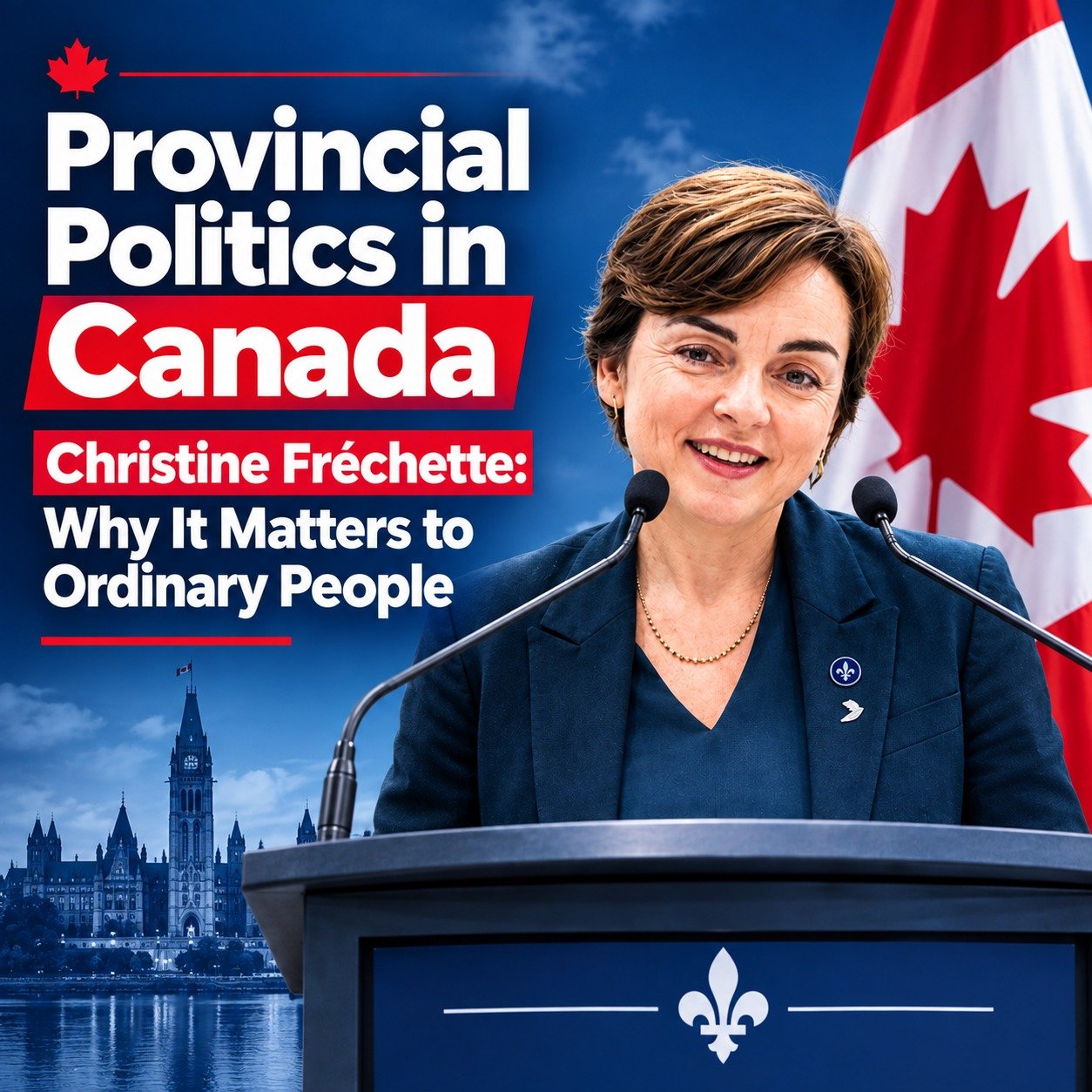
Christine Frechette
Introduction:
When people hear the words provincial politics, they may think about politicians, elections and debates inside a provincial legislature. But provincial politics is much more than that. It has a direct impact on everyday life.
From hospitals and schools to highways, housing, employment rules and public services, provincial governments make decisions that affect millions of Canadians. That is why understanding provincial politics is important for ordinary citizens.
In Quebec, this discussion has become particularly important with Christine Frechette becoming Premier in April 2026. Her rise from business and economic-development roles to cabinet minister and then Premier represents an important new chapter in Quebec politics.
Her government now faces major questions about healthcare, affordability, infrastructure, immigration, economic growth, environmental protection and Quebec’s relationship with Ottawa and the United States.
This article examines both provincial politics in Canada and Christine Frechette political record, leadership, challenges and priorities.

What Is Provincial Politics?
Provincial politics is the process through which provincial governments make laws, policies and financial decisions within areas of provincial responsibility.
Canada is a federation. This means powers are divided between the federal government and provincial governments.
Provincial governments have major responsibilities in areas such as:
• Healthcare
• Education
• Labor and employment standards
• Highways and transportation
• Natural resources
• Housing-related policies
• Municipal affairs
• Many social programs
• Provincial taxation
• Economic development
Because these areas affect daily life, provincial politics is extremely important to ordinary Canadians.
Why Does Provincial Politics Matter to Ordinary People?
Provincial political decisions can affect people even when they do not follow politics closely.
A person may encounter provincial government decisions when visiting a hospital, sending a child to school, applying for government assistance, driving on a provincial highway or looking for employment.
For families, provincial policies can influence childcare, education, healthcare and housing.
For workers, employment standards, labor laws and economic policies can affect working conditions and opportunities.
For businesses, taxation, regulations, infrastructure and economic-development policies can influence investment and job creation.
This is why provincial elections matter.
How Does Provincial Politics Affect Healthcare?
Healthcare is one of the most important areas of provincial responsibility.
Provincial governments play a major role in funding and administering healthcare systems. Political decisions can therefore influence:
• Hospital funding
• Staffing
• Access to doctors
• Emergency services
• Wait times
• Long-term care
• Mental-health services
• Primary care
However, healthcare results cannot be judged simply by looking at how much money a government spends.
A serious political assessment should ask whether increased spending produces measurable improvements for patients.
For example:
Are wait times falling?
Are hospitals better staffed?
Can patients access doctors more easily?
Are healthcare outcomes improving?
These are stronger measures of government performance than political announcements alone.
How Does Provincial Politics Affect Education?
Provincial governments play a central role in Canada’s education system.
They influence school funding, curriculum, education standards, teacher policies and many aspects of colleges and universities.
Political decisions can affect students through:
• School infrastructure
• Teacher recruitment
• Class sizes
• Educational funding
• Tuition policies
• Training programs
• College and university programs
For young people, education policy can also affect their future employment opportunities.
How Does Provincial Politics Affect Jobs?
Provincial governments influence employment through labor laws, minimum-wage rules, workplace standards, occupational health and safety regulations and economic-development programs.
A government that encourages investment and business expansion may help create employment.
At the same time, regulations can affect business costs.
The challenge for provincial governments is finding a balance between protecting workers and creating an environment where businesses can grow.
How Does Provincial Politics Affect the Cost of Living?
The cost of living is one of the biggest political concerns for ordinary families.
Provincial governments can influence household expenses through:
• Provincial taxes
• Energy policies
• Transportation
• Housing programs
• Childcare
• Public services
• Employment policies
• Economic-development programs
However, inflation and household costs are not controlled by provincial governments alone.
Federal policies, global markets, interest rates, energy prices and international events can also affect the cost of living.
That is why journalists should avoid blaming one level of government for every increase in prices.
Housing and Rent: What Role Does the Province Play?
Housing is another complicated issue.
Provincial governments can influence housing through planning rules, building regulations, housing programs and infrastructure investment.
Municipal governments also play an important role in zoning and development approvals.
Interest rates, population growth, construction costs and supply and demand can also influence rents and home prices.
Therefore, solving the housing crisis requires cooperation among provincial, federal and municipal governments.
Roads, Highways and Infrastructure
Provincial governments are major infrastructure decision-makers.
They can determine which highways receive funding, which transportation projects receive priority and how public infrastructure is developed.
Infrastructure investment can have economic benefits because better roads and transportation networks can reduce travel times, support businesses and improve connections between communities.
But large infrastructure projects also involve major public spending.
The important question is therefore not simply:
“How much money is being spent?”
The better question is:
“What are taxpayers receiving in return?”
How Can Citizens Hold Provincial Governments Accountable?
Citizens have several tools for holding governments accountable.
They can:
• Vote in provincial elections
• Contact their MNA or MLA
• Follow legislative debates
• Examine provincial budgets
• Attend public meetings
• Read independent investigations
• Ask questions of elected officials
• Compare government promises with actual results
Journalists also play an important role by challenging government claims and checking whether public money is being spent effectively.
Who Is Christine Frechette?
Christine Frechette is a Quebec politician and member of the Coalition Evener Québec (CAQ).
She was first elected as the MNA for Sanguine on October 3, 2022.
Before entering elected politics, Frechette had a professional background in economics, international relations, economic development and business organizations.
Her education includes a bachelor’s degree in business administration, specializing in economics and international trade, from HEC Montréal and a master’s degree in international relations from Université Laval.
Her professional career included leadership roles connected to economic development and international relations.
That background became important as she moved into provincial politics
Christine Frechette personal detail:
Christine Frechette
Christine Frechette is a Canadian politician who became Quebec’s 33rd Premier in April 2026. She was born on August 15, 1970, in Trois-Rivières, Quebec.
Before entering politics, Frechette built a career in areas including international affairs, political analysis, economic development, and business organizations. She was elected to the Quebec National Assembly for Sanguine in 2022.
She later held important cabinet responsibilities, including portfolios related to Immigration, Francization and Integration, as well as Economy, Innovation and Energy. Her political career has focused on Quebec’s economy, immigration, energy, economic development, and the protection of the French language.
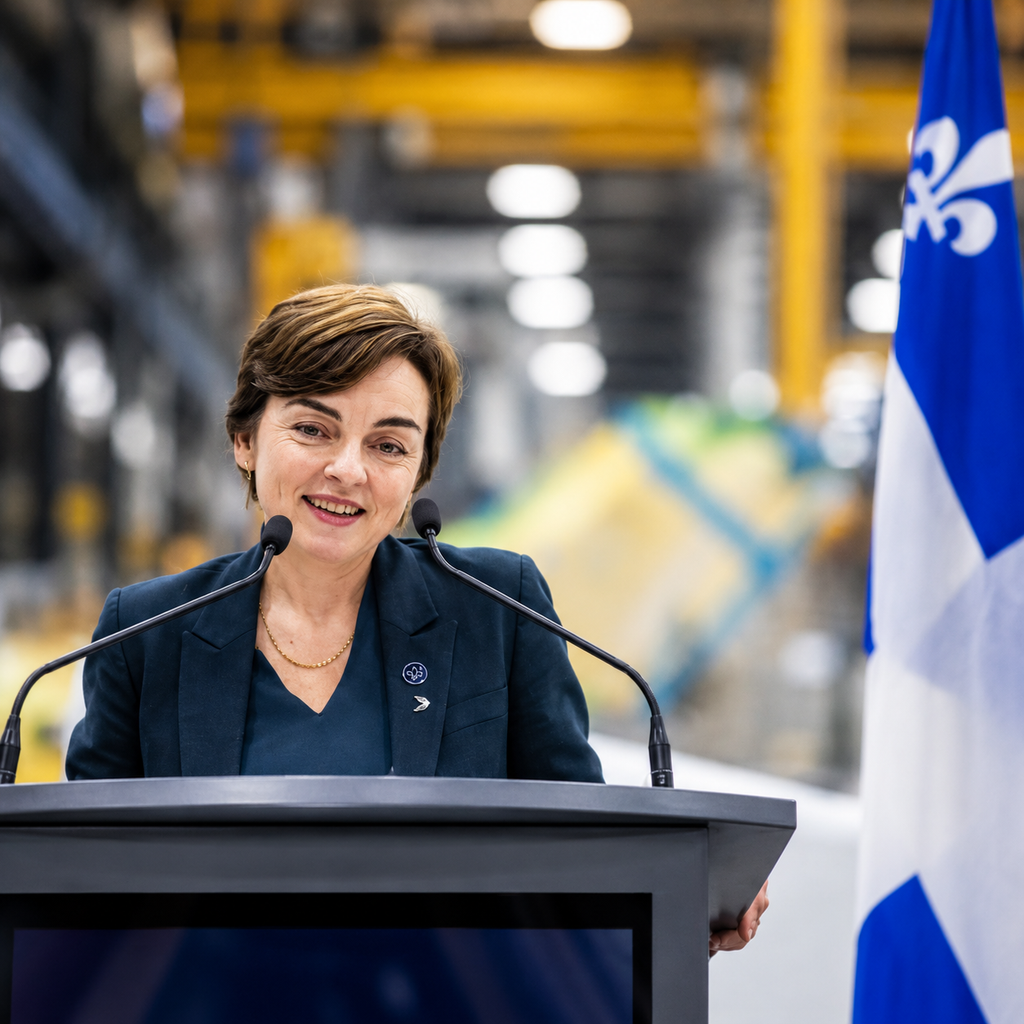
Guy Nadeau
Christine Frechette is married to Guy Nadeau, a businessman and finance professional.
Nadeau has worked in the financial sector and has been identified as a Vice-President at Desjardins Enterprises – Montréal.
An interesting detail about their relationship is that Frechette and Nadeau grew up in the Trois-Rivières-Oust area. Their childhood homes were reportedly only a few streets apart, although they did not know each other at the time. They later met as adults and eventually became a couple.

Olivier Christine Frechette:
Christine Frechette has one son, Olivier.
Olivier is from Frechette previous relationship with François Rebelled, a former Quebec politician. Some sources refer to him as Olivier Rebelled-Frechette.
Frechette has spoken positively about her son’s personal discipline and his interest in fitness and nutrition. However, Olivier generally maintains a private life and there is limited verified public information about him.

Mother’s Family Background:
Christine Frechette grew up in a middle-class family in Trois-Rivières.
Public biographical information about her mother is relatively limited. Some accounts describe her mother as a piano teacher who taught children at home, but this detail should be treated cautiously unless confirmed by a reliable primary source.
Her maternal family has also been associated with La Bay, Quebec.
Father’s Family Background
Frechette father also came from a working and technical background.
Some biographical accounts describe him as having worked for Hydro-Québec as a technician/welder connected with nuclear-reactor-related work. However, this specific occupational detail is not consistently documented in major public biographies.
For a professional or reporter-level profile, it is therefore better to identify this as a reported family detail rather than an independently confirmed fact unless a reliable source is available.
Christine Frechette Political Career:
Frechette entered the Quebec National Assembly in 2022.
Her political career developed quickly.
She served as Minister of Immigration, Francization and Integration before moving into economic and energy responsibilities.
Her ministerial experience gave her exposure to some of Quebec’s most politically sensitive issues.
Immigration, French-language integration, economic development and energy policy all involve significant public debate.
Her movement between these portfolios eventually positioned her for a much larger political role.
How Did Christine Frechette Become Premier?
Christine Frechette became Premier of Quebec in April 2026 after succeeding François Legal.
She was sworn in as Quebec’s 33rd Premier on April 15, 2026.
Her arrival marked a new phase for the CAQ government.
The central question was no longer simply whether she could succeed as a cabinet minister.
The question became whether she could build her own political identity and convince Quebec voters that the CAQ still deserved their support.
What Are Christine Frechette Priorities?
Her government’s agenda has focused on issues including:
• Cost of living
• Economic growth
• Infrastructure
• Government efficiency
• Quebec’s national identity
• Healthcare
• Immigration
• Energy
• Relations with Ottawa
The challenge is turning these priorities into measurable results.
Political promises are easy to announce.
Delivering them is much harder.
Can Frechette Build Her Own Political Identity?
One of the biggest political questions surrounding Frechette is how different her government will ultimately be from François Leg Ault’s.
She inherited the CAQ government, its policies and many of its political challenges.
However, every new Premier eventually needs to establish a distinct identity.
Frechette has emphasized economic development, infrastructure, affordability and government efficiency.
Whether voters see these policies as a genuine new direction or simply a continuation of the Legal era will become clearer over time.
Christine Frechette and Healthcare
Healthcare will be one of the most important tests of her leadership.
Quebec voters are likely to judge the government on practical questions:
Are hospital wait times improving?
Are more healthcare professionals available?
Can patients access family doctors?
Are emergency departments under less pressure?
A government can announce billions of dollars in healthcare spending, but citizens ultimately want better services.
Therefore, measurable outcomes will be essential when evaluating Frechette government.
Christine Frechette and Immigration
Immigration has been one of Frechette most important political files.
As former Minister of Immigration, Francization and Integration, she was directly involved in policies affecting immigration and French-language integration.
The government must balance several competing pressures:
• Labor shortages
• Housing capacity
• French-language integration
• Public services
• Immigration levels
• Economic needs
In 2026, the government announced the reactivation of the Programmed de experience Québécoise (PEQ) for two years.
The long-term question is whether immigration policy can simultaneously support Quebec’s economy while maintaining sufficient housing, public services and French-language integration.
Christine Frechette and the Economy
Economic development is particularly relevant to Frechette because of her professional background.
Quebec needs investment, jobs and economic growth while facing international economic uncertainty.
Her government must therefore address:
• Business investment
• Industrial development
• Energy
• Innovation
• International trade
• Labor shortages
• Infrastructure
The United States is especially important because Quebec businesses depend heavily on access to the American market.
Donald Trump and Quebec’s Trade Challenge
U.S. trade policy is another major issue for Quebec.
Tariffs can increase the cost of exported goods, reduce competitiveness and disrupt supply chains.
For Quebec manufacturers and exporters, the American market is extremely important.
This creates pressure on the provincial government to work closely with Ottawa while also defending Quebec’s economic interests.
The province cannot independently control Canadian trade policy, but it can support affected industries, promote economic diversification and work with federal authorities.
Christine Frechette and Mark Carney
Relations between Quebec City and Ottawa are also important.
Frechette’s government and Prime Minister Mark Carney’s federal government may disagree on certain issues, but cooperation is necessary on infrastructure, economic development, immigration and other areas.
In June 2026, Quebec and Ottawa announced nearly $10 billion in infrastructure agreements, covering priorities including healthcare, public transit, housing and higher education.
Such agreements demonstrate that provincial and federal governments can cooperate even when political differences exist.
The Bill Q-5 Controversy
One of the most important tests for Frechette government is Bill Q-5.
The proposal was designed to accelerate the approval process for major projects considered to be in the national interest.
The government argued that faster approvals could support economic growth and major investment.
Critics, however, raised concerns about environmental protection, public consultation and the possibility of reducing or bypassing certain regulatory requirements.
The bill failed to pass during the spring 2026 session.
That created an important political setback for the government.
Why Is Bill Q-5 Important?
The debate surrounding Q-5 represents a much bigger question:
Can Quebec accelerate economic development without weakening environmental protection and public trust?
Supporters can argue that lengthy approval processes can delay investment, infrastructure and job creation.
Critics can argue that environmental reviews and public consultation exist for important reasons.
The strongest solution would be to improve the efficiency of the approval process while maintaining clear environmental safeguards and meaningful consultation.
Speed and environmental responsibility do not necessarily have to be opposites.
The Reporter Question: Can Frechette Guarantee Environmental Protection?
This is one of the strongest questions journalists can ask:
Can Christine Frechette guarantee that faster approvals under Bill Q-5 will not come at the expense of environmental protection?
A verbal promise is not enough.
The government should identify:
• Which environmental rules remain mandatory
• Which rules could be modified
• Who decides whether a project is in the national interest
• What consultation is required
• How Indigenous consultation is protected
• Whether decisions can be challenged
• Who monitors compliance
• What happens if environmental damage occurs
These details would allow the public to judge the government’s commitment based on law rather than political statements.
If Bill Q-5 Returns, What Should Change?
If the government brings Q-5 back, it could face pressure to strengthen:
Environmental safeguards
Public consultation
Indigenous consultation
Transparency
Independent oversight
Clear project-selection criteria
The government would need to explain why each change is necessary and how it addresses concerns raised during the previous debate.
What Are Frechette Biggest Political Challenges?
Frechette faces several major challenges.
The first is public confidence.
The second is healthcare performance.
The third is affordability and housing.
The fourth is immigration and integration.
The fifth is economic uncertainty and trade tensions.
The sixth is maintaining CAQ unity.
The seventh is establishing a political identity separate from François Legal.
The eighth is balancing economic development with environmental protection.
These challenges will help determine whether her government succeeds.
What Are the Strongest Criticisms of Her Government?
Criticism should be separated into two categories.
The first category consists of evidence-based concerns supported by government data, independent experts, official reports or documented outcomes.
The second category consists of normal political attacks made by opposition parties.
A responsible journalist should not automatically accept either side’s narrative.
The correct approach is to ask:
What does the evidence show?
Is Frechette an Effective Leader?
It is still too early to make a final judgment.
She became Premier in April 2026, meaning her government is still relatively young.
Her leadership should be judged over time through measurable outcomes.
Important indicators include:
• Economic growth
• Employment
• Healthcare performance
• Housing construction
• Infrastructure delivery
• Government spending
• Immigration outcomes
• French-language indicators
• Public satisfaction
A Premier’s success cannot be measured simply by the number of announcements made.
Can Frechette Lead the CAQ to Another Election Victory?
No serious political analyst can guarantee the result of a future election.
Her political future will depend on several factors:
• Public opinion
• Economic conditions
• Healthcare performance
• Housing affordability
• Immigration policy
• Opposition strength
• CAQ unity
• Her personal popularity
• Whether voters believe her government delivered
If voters feel that their daily lives have improved, the government will have a stronger argument for re-election.
If voters remain dissatisfied with healthcare, housing or affordability, opposition parties will have an opportunity.
What Would a Change of Government Mean for Quebec?
A change in government could lead to different policies on:
• Healthcare
• Education
• Immigration
• Housing
• Energy
• Environment
• Taxes
• Infrastructure
• Relations with Ottawa
This is why provincial elections matter.
Voters are not simply choosing a person.
They are choosing a political direction for the province.
What Should Journalists Verify?
Journalists covering Frechette government should verify government claims using measurable evidence.
For example:
If the government says healthcare has improved, examine wait-time statistics.
If it says housing is becoming more affordable, examine housing costs and construction data.
If it says immigration policy is solving labor shortages, examine employment and labor-market data.
If it says a major-project law will create economic growth, examine investment and employment evidence.
If it says environmental protection remains strong, examine the actual legislation and regulatory safeguards.
This is the difference between political reporting and political promotion.
Are Quebecers Better Off Under Frechette?
t is too early to give a definitive answer.
Frechette became Premier only in April 2026.
Her government needs more time to demonstrate whether its policies are producing measurable improvements.
The correct journalistic question is not:
“Is Christine Frechette good or bad?”
The better question is:
“What has changed under her government, and what evidence proves that those changes have improved people’s lives?”
What Will Determine Christine Frechette Political Legacy?
Her legacy will ultimately depend on results.
If her government improves healthcare, supports economic growth, makes infrastructure delivery more effective, manages immigration successfully and improves affordability, she could establish herself as a successful Quebec Premier.
If major problems remain unresolved and public trust declines, critics will argue that her government failed to deliver meaningful change.
Her handling of Bill Q-5 could also become an important part of that legacy because it represents the difficult balance between economic development, environmental protection and public consultation.
Major Initiatives and Infrastructure Projects in 2026:
In 2026, Christine Frechette government was involved in several major infrastructure, clean-energy, healthcare, transportation, and regional development initiatives. Key developments included:
• Churchill Falls & Gull Island: In August 2026, Quebec and the federal government announced a nearly C$70 billion clean-energy package involving Hydro-Québec and Newfoundland and Labrador Hydro. The agreement includes upgrades to Churchill Falls and development of the Gull Island hydroelectric project.

• Québec–Canada Infrastructure Accord: A C$10 billion, 10-year infrastructure agreement was unveiled in June 2026, supporting investments in public transit, housing, healthcare, education, and other public infrastructure.
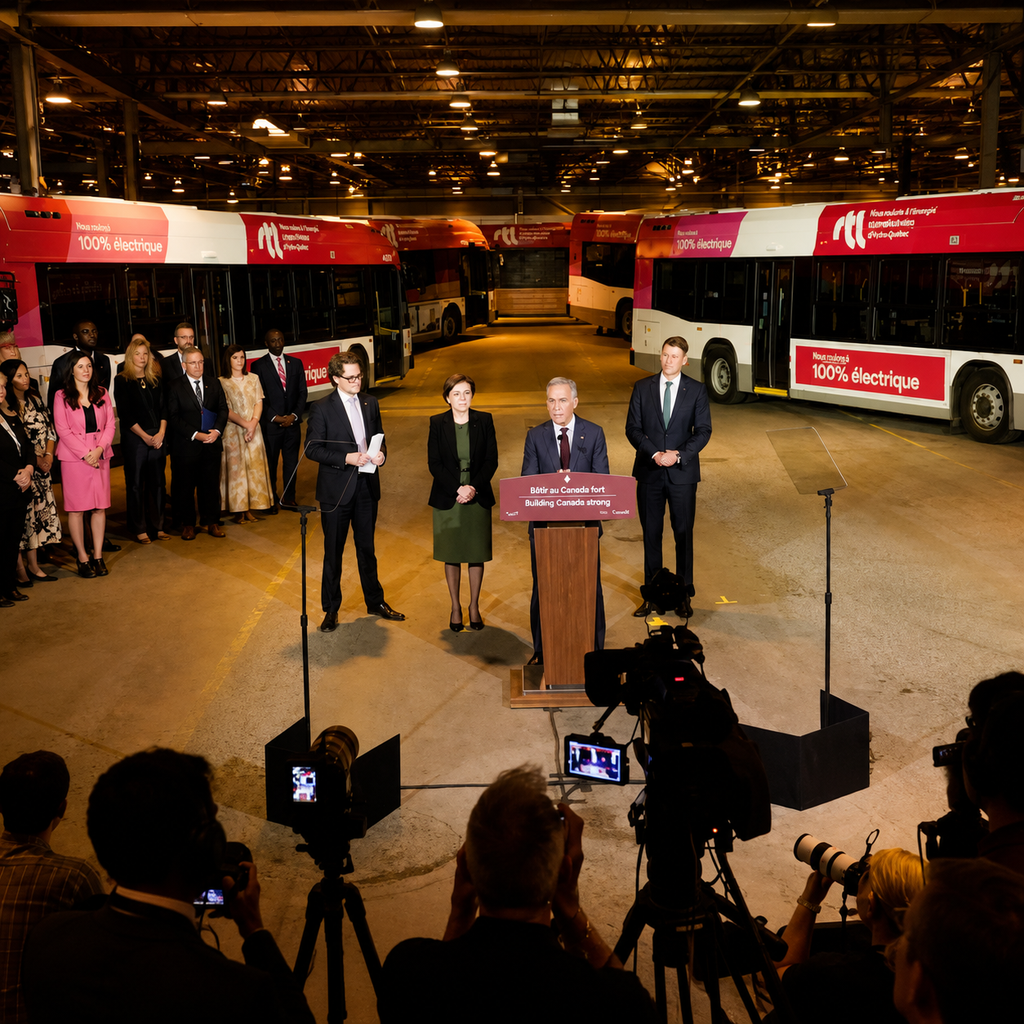
• Third Link Highway Project: In August 2026, the proposed Quebec City–Lévi’s Third Link project received 21 company proposals following an international call for expressions of interest.
• Environmental Assessment Agreement: In July 2026, Quebec and federal authorities advanced a draft cooperation agreement intended to coordinate environmental assessments and streamline the review of major projects.
The Key Questions Quebec Voters Should Ask
The most important way to evaluate Christine Frechette government is to look beyond political speeches and promises and ask whether government policies are producing real results for ordinary Quebecers.
Are healthcare services improving?
Are hospital wait times decreasing? Are more patients able to access doctors and primary care? Has the government improved staffing levels and reduced pressure on hospitals? The real test of healthcare policy is whether patients experience better and faster services.
Is life becoming more affordable?
Are families paying less or seeing slower increases in the costs of housing, transportation, energy, food and other essentials? Government announcements should be compared with actual household economic data.
Are housing conditions improving?
Is Quebec building enough homes to meet demand? Are rents becoming more manageable? Can young people and families realistically afford to buy or rent a home? Housing policy should ultimately be measured by supply, affordability and access.
Are jobs and investment growing?
Is Quebec attracting new investment and creating good-quality jobs? Are businesses expanding, and are workers benefiting from economic growth? The government must demonstrate that its economic policies are producing measurable employment and investment results.
Is immigration being managed effectively?
Can Quebec attract the workers it needs while maintaining adequate housing, healthcare and public services? Is French-language integration working? A successful immigration policy must balance economic needs with the province’s capacity to welcome and integrate newcomers.
Is Quebec’s French language and culture being protected?
Are government policies strengthening the use of French in workplaces, education and public life?
The government has made protection of Quebec’s identity a major priority, but the effectiveness of those policies should be measured through real language-use trends and outcomes.
Are major projects being approved efficiently without weakening environmental safeguards?
This is one of the most important questions surrounding Bill Q-5. Quebec needs economic development, investment and major infrastructure, but faster approvals should not automatically mean weaker environmental protection or reduced public and Indigenous consultation.
The government should clearly explain which environmental safeguards will remain in place, who will make major-project decisions, how public consultation will work and what independent oversight will exist.
And is the government transparent enough for taxpayers to hold it accountable?
Those questions will help determine whether Christine Frechette successfully establishes her own political legacy or becomes remembered primarily as the successor to François Legault.
For ordinary Quebecers, however, the most important issue is not political personalities.
It is whether provincial government decisions make everyday life better, safer, more affordable and more prosperous.
Final Verdict:
Provincial politics is not something that exists only inside a legislature.
It affects hospitals, schools, workers, families, businesses, roads, housing, taxes and public services.
That is why ordinary citizens should pay attention to provincial elections and government decisions.
Christine Frechette government represents a new phase in Quebec politics. She brings experience in economic development, international relations, immigration and cabinet government to the Premier’s office.
But her biggest test is now performance.
Quebec voters will ultimately judge her government not only by what it promises, but by what it actually delivers.
And is the government transparent enough for taxpayers to hold it accountable?
Those questions will help determine whether Christine Frechette successfully establishes her own political legacy or becomes remembered primarily as the successor to François Legault.
For ordinary Quebecers, however, the most important issue is not political personalities.
It is whether provincial government decisions make everyday life better, safer, more affordable and more prosperous.
Christine Frechette: Can Ambition Become Real Results?
Christine Frechette political future will depend on one simple test: can she convert political ambition into results that people can actually see and feel?
Quebec needs strong leadership on several fronts at the same time. Economic growth must create meaningful opportunities, infrastructure investment must deliver long-term value, healthcare must become more accessible, and housing must remain within reach for ordinary families. These are not issues that can be solved through announcements alone.
Frechette opportunity is significant because successful leadership could strengthen
Quebec’s economy while also improving public confidence in government. However, the risks are equally clear. Large projects, spending commitments and ambitious policies must be carefully managed so that taxpayers see real value.
For voters, the final judgment will be practical. They will ask whether healthcare is easier to access, whether housing is becoming more affordable, whether good jobs are being created and whether government decisions are improving their communities.
Our verdict:
Frechette should be judged neither by political headlines nor by promises alone. Her strongest legacy will come from measurable achievements. If she can connect Quebec’s economic ambitions with the everyday needs of its people, she has the opportunity to establish herself as a consequential provincial leader.
Table of Contents

Leave a Reply