Artificial Intelligence
Introduction:
Artificial Intelligence Evolution (AI) has become one of the most important technologies of the modern world. It is changing the way people work, communicate, create content, solve problems, and interact with technology. From simple computer programs to advanced AI systems capable of generating text, images, videos, and analyzing complex information, AI has developed rapidly over the past several decades.
The history of Artificial Intelligence is a long journey that began with early ideas about machine intelligence and logical reasoning. Over time, researchers introduced important concepts, experiments, and technologies that helped shape modern AI. Key developments such as the Turing Test, the Dartmouth Conference, machine learning, neural networks, and deep learning played an important role in this evolution.
Today, Artificial Intelligence includes a wide range of tools and technologies, including ChatGPT, Claude, Gemini, Copilot, Grok, Midjourney, Runway, Cursor, robotics, and brain-computer interfaces. Understanding how AI developed from its early beginnings to today’s advanced systems helps us understand both its opportunities and the challenges it may create for the future.
What is Artificial Intelligence, and when did AI officially begin as an academic field?
Artificial Intelligence (AI) is the field of creating computer systems that can perform tasks requiring human intelligence, such as learning, reasoning, understanding language, recognizing patterns, solving problems, and making decisions.
AI is generally considered to have officially begun as an academic field in 1956 at the Dartmouth Conference in Hanover, New Hampshire. The workshop was organized by John McCarthy, Marvin Minsky, Nathaniel Rochester, and Claude Shannon. McCarthy proposed the workshop in 1955 and coined the term “artificial intelligence.”
Earlier work in computing, logic, cybernetics, and neural networks provided important foundations, but 1956 is widely regarded as the formal beginning of AI as an academic field.
Who Coined the Term “Artificial Intelligence”?
John McCarthy coined the term “artificial intelligence” in the 1955 proposal for the Dartmouth Summer Research Project.
The 1956 Dartmouth Conference brought researchers together to explore whether machines could perform intelligent tasks. Key topics included:
- Computer reasoning and problem-solving
- Symbolic logic and language
- Neural networks
- Machine learning
- Game-playing programs
- Automated information processing
The researchers believed that aspects of human intelligence could be described precisely enough for machines to simulate them. The conference helped establish AI as a new academic field.
What was Alan Turing’s contribution to Artificial Intelligence, and what is the Turing Test?
Alan Turing was one of the early thinkers who laid the foundations of artificial intelligence. His major contributions included:
- Developing the concept of the universal machine, a foundation of modern computing.
- Asking whether machines could think in his 1950 paper, “Computing Machinery and Intelligence.”
- Suggesting that machine intelligence could be judged by observable behavior rather than consciousness.
- Discussing the possibility of machines learning from experience.
What Is the Turing Test?
The Turing Test, originally called the “imitation game,” evaluates whether a machine can communicate in a way that is difficult to distinguish from a human.
In the classic test, a human evaluator communicates by text with both a human and a machine without knowing which is which. If the evaluator cannot reliably identify the machine, it is considered to have passed the test.
However, the test measures human like conversational behavior, not necessarily consciousness, true understanding, or general intelligence.
What was the Logic Theorist, and why is it considered an important early AI program?
- The Logic Theorist was an early AI program developed in 1956 by Allen Newell, Herbert A. Simon, and Cliff Shaw. It was designed to prove mathematical theorems from Principia Mathematica.
- It was important because it showed that computers could reason, manipulate symbols, solve problems, and use heuristic strategies, not just perform numerical calculations. It helped establish symbolic AI and the idea that human reasoning could be modeled computationally.
- How Did AI Develop from the 1960s to the 1990s?
- 1960s: Early AI and Symbolic Reasoning
- AI research focused on rule-based systems and symbolic reasoning. Important projects included General Problem Solver, ELIZA, SHRDLU, early robotics, computer vision, and natural-language processing. Researchers were highly optimistic about rapid progress.
- 1970s: Knowledge and the First AI Winter
- Researchers realized that intelligent systems needed large amounts of knowledge and struggled with real-world complexity. Limited computing power and disappointing results led to reduced funding, known as the first AI winter.
- 1980s: Expert Systems
- AI gained renewed interest through expert systems such as MYCIN and XCON. These systems used specialized knowledge and rules for tasks such as medical diagnosis and computer configuration. However, they were expensive and difficult to maintain, leading to another decline in funding.
- 1990s: Machine Learning
- AI increasingly shifted from hand-coded rules toward statistical methods and machine learning. Neural networks, probabilistic models, speech recognition, language processing, computer vision, and robotics advanced.
- A major milestone came in 1997, when IBM’s Deep Blue defeated world chess champion Garry Kasparov, demonstrating the growing power of AI systems.
What was ELIZA, and why is it considered an important milestone in the history of chatbots?
ELIZA was an early natural-language processing program created by Joseph Weizenbaum at MIT in the mid-1960s. Its most famous script, DOCTOR, imitated a Rogerian psychotherapist by identifying keywords in a user’s statements and responding with scripted questions or restatements.
For example, if a user wrote, “I feel unhappy,” ELIZA might respond, “Why do you feel unhappy?”
ELIZA is considered an important chatbot milestone because it:
- Demonstrated that simple pattern matching could produce surprisingly convincing conversation.
- Showed how computers could interact with people using ordinary language.
- Became one of the first widely known examples of a conversational AI system.
- Revealed the tendency of people to attribute understanding and empathy to machines, even when the system had no genuine comprehension a phenomenon sometimes called the ELIZA effect.
However, ELIZA did not truly understand language or maintain a sophisticated model of the user. Its importance lies in demonstrating the social and psychological impact of conversational interfaces, rather than in possessing human-like intelligence.
What were AI Winters, and why did AI research experience periods of reduced funding and interest?
AI Winters
AI winters were periods when enthusiasm, funding, and investment in artificial intelligence declined after ambitious expectations were not met.
The first Artificial Intelligence winter occurred roughly in the 1970s. Early AI systems worked in limited situations but struggled with real-world complexity. Limited computing power, memory, language understanding, and perception led to disappointing results and reduced funding.
The second AI winter occurred mainly in the late 1980s and early 1990s. Expert systems had created strong commercial interest, but they were expensive, difficult to maintain, and limited to specific tasks. Many expected applications failed to become profitable.
The main causes of AI winters included overpromising, technical limitations, high costs, brittle rule-based systems, and economic changes.
However, AI research continued. These periods encouraged researchers to set more realistic goals and increasingly focus on machine learning, larger datasets, better algorithms, and greater computing power, which later helped drive major advances in AI.
What was IBM Deep Blue, and how did it defeat chess champion Garry Kasparov in 1997?
IBM Deep Blue was a specialized chess-playing computer developed by IBM. It evolved from a system called Deep Thought, created by Carnegie Mellon researchers, and was designed specifically to analyze chess positions at great speed.
In May 1997, Deep Blue defeated world chess champion Garry Kasparov in a six-game match held in New York, winning 3½–2½. It was the first time a reigning world champion had lost a match to a computer under standard tournament conditions.
Deep Blue succeeded through a combination of:
- Massive search capacity: Its parallel hardware could examine roughly 200 million chess positions per second.
- Specialized chess processors: Custom chips rapidly evaluated possible moves.
- Advanced evaluation functions: The system assessed factors such as material, king safety, pawn structure, and positional advantage.
- Opening databases: It used extensive records of master-level games and established opening knowledge.
- Endgame databases: For certain simplified positions, it could consult precomputed optimal play.
- Grandmaster assistance: Chess experts helped refine its programming and evaluation strategies.
Deep Blue did not play chess by thinking like a human or possessing broad, general intelligence. Its achievement came primarily from high-speed calculation, specialized algorithms, and carefully engineered chess knowledge. Nevertheless, the victory was a major milestone because it demonstrated that a machine could outperform the world’s strongest human player in a complex intellectual game.
How did Siri and Amazon Alexa help bring Artificial Intelligence into everyday life?
Siri and Amazon Alexa helped bring artificial intelligence into everyday life by making AI accessible through natural spoken conversation rather than specialized software or technical interfaces.
Siri
Apple introduced Siri on the iPhone 4S in 2011. Users could ask questions, send messages, set reminders, get directions, check the weather, or control phone functions using voice commands. Siri combined speech recognition, natural-language processing, machine learning, and web-based services to interpret requests and provide responses.
Amazon Alexa
Amazon introduced Alexa with the Echo smart speaker in 2014. Alexa allowed users to interact with computers hands-free from anywhere in a room. It could play music, answer questions, manage calendars and shopping lists, control smart-home devices, and run third-party functions called skills.
Why they were important
Together, Siri and Alexa:
- Popularized voice-based interaction with computers.
- Made AI a routine part of activities such as communication, navigation, shopping, entertainment, and home automation.
- Helped normalize technologies such as speech recognition and natural-language understanding.
- Created large consumer ecosystems in which developers could build applications and services.
- Increased public awareness of both the capabilities and limitations of AI.
They did not possess human-like understanding or general intelligence. Instead, they used cloud-based machine learning and specialized services to recognize speech, interpret requests, retrieve information, and perform predefined actions. Their importance was that they made these AI capabilities convenient, inexpensive, and familiar to millions of people.
Why was the launch of ChatGPT in November 2022 a major milestone in the evolution of Generative AI?
The launch of ChatGPT on November 30, 2022 was a major milestone because it made generative AI broadly accessible through a simple conversational interface. Built on OpenAI’s GPT language models, ChatGPT could generate human-like text in response to prompts and maintain a conversational context.
Its importance included:
- Mass adoption: Millions of people quickly began using it for writing, brainstorming, coding, tutoring, translation, and summarization.
- Natural-language interaction: Users could communicate with an AI by describing what they wanted in ordinary language, without learning complex software commands.
- Demonstration of general-purpose generation: ChatGPT showed that one model could perform many different language tasks rather than serving only one narrow application.
- Public awareness: It brought generative AI into mainstream discussions about education, employment, creativity, misinformation, and the future of work.
- Acceleration of investment and competition: Its popularity led technology companies and startups to rapidly develop competing large language models and AI-powered products.
- A new software model: ChatGPT helped popularize the idea of using a conversational AI as an adaptable assistant, rather than interacting with separate tools for every task.
ChatGPT did not represent the invention of generative AI or human-level intelligence. Earlier systems could already generate text, images, music, and code. Its breakthrough was combining large-scale language modeling, instruction tuning, and reinforcement learning from human feedback into a system that was easy for the general public to use.
It also exposed important limitations, including hallucinated information, bias, uneven reasoning, and difficulty reliably citing sources. Even so, its launch marked the point when generative Artificial Intelligence moved from a specialized research and technology topic into a widely used consumer technology.
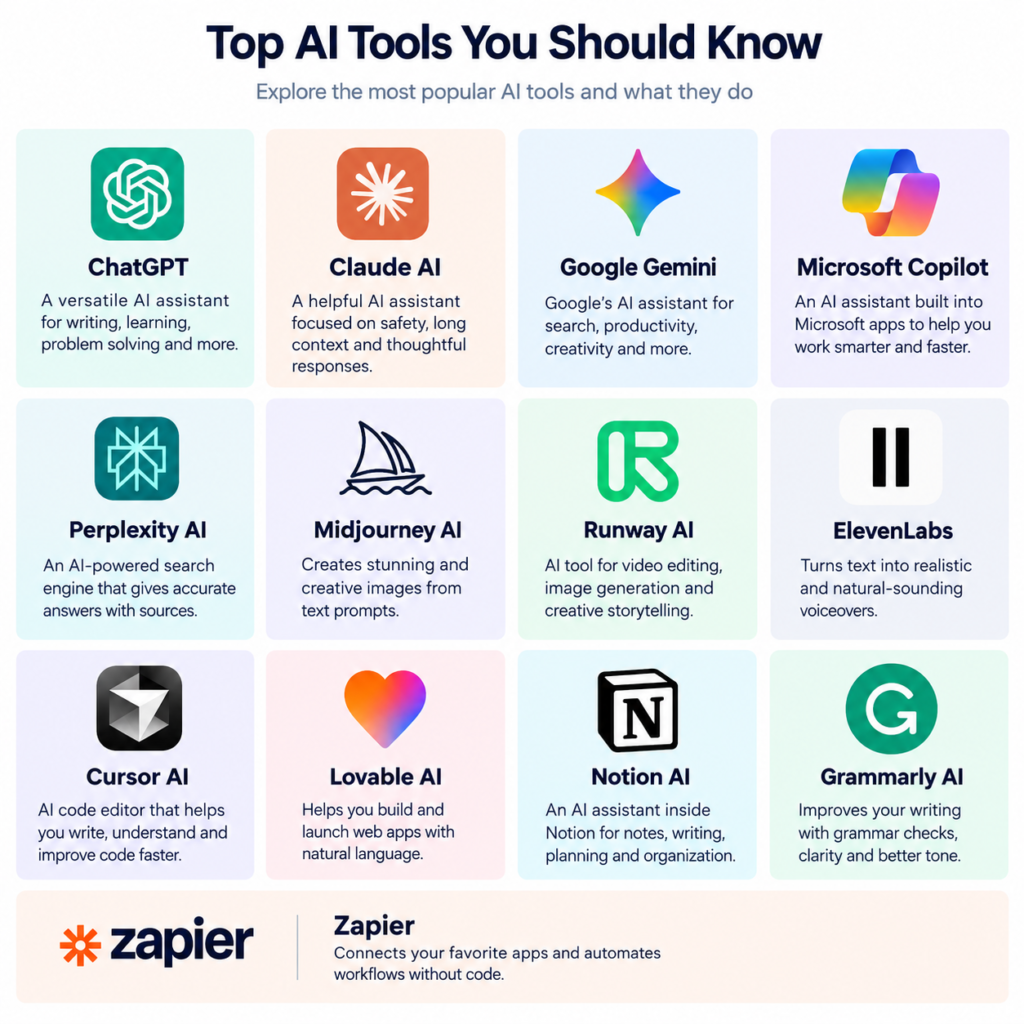
What are AI tools, and how do they help automate everyday tasks?
AI tools are software applications that use artificial-intelligence techniques such as machine learning, natural-language processing, computer vision, or generative models to perform tasks that traditionally require human judgment or effort.
They help automate everyday tasks by:
- Writing and editing: Drafting emails, reports, summaries, product descriptions, and social-media posts.
- Communication: Translating languages, transcribing meetings, creating captions, and answering routine customer questions.
- Organization: Managing calendars, setting reminders, sorting messages, extracting information from documents, and creating task lists.
- Research and information retrieval: Summarizing articles, comparing information, identifying key points, and answering questions.
- Data processing: Classifying records, detecting patterns, creating forecasts, and generating spreadsheets or reports.
- Personal assistance: Powering voice assistants that control devices, provide directions, play media, or answer questions.
- Creative work: Generating or editing images, videos, music, presentations, and other content.
- Workplace automation: Routing support requests, screening documents, monitoring systems, and triggering actions in business software.
Most Artificial Intelligence tools automate tasks by recognizing patterns in input, predicting an appropriate result, and either producing an output or carrying out an action. For example, an email assistant may identify the message’s purpose and suggest a reply, while a smart-home system may learn routines and adjust lighting automatically.
AI tools generally assist rather than replace human oversight. They can produce inaccurate or biased results, misunderstand context, mishandle sensitive information, or make confident errors. Important decisions and outputs should therefore be reviewed by a person.
What is ChatGPT?
ChatGPT is a conversational artificial-intelligence assistant developed by OpenAI. It uses large language models to understand prompts and generate human-like responses in natural language.
ChatGPT can help with tasks such as:
- Answering questions and explaining concepts
- Writing, editing, and summarizing text
- Brainstorming ideas and planning projects
- Translating and working with different languages
- Generating and debugging computer code
- Analyzing certain documents, images, and data
- Assisting with research and learning
It generates responses by predicting likely sequences of words based on patterns learned from large amounts of data. It does not think or understand exactly as a human does, and it can produce inaccurate or fabricated information, sometimes called hallucinations. Its answers should therefore be reviewed, especially for important decisions or factual claims.
What is Claude AI?
Claude AI is a conversational Artificial Intelligence assistant developed by Anthropic. It is powered by large language models designed to understand and generate natural language.
Claude can help with tasks such as:
- Answering questions and explaining ideas
- Writing, editing, and summarizing documents
- Analyzing long texts and uploaded files
- Generating, reviewing, and debugging code
- Brainstorming and planning
- Extracting information and organizing data
- Translating and rewriting content
Anthropic emphasizes making Claude helpful, reliable, and safer to use, using an approach called Constitutional Artificial Intelligence to guide its behavior and reduce harmful or misleading responses.
Like other Artificial Intelligence assistants, Claude does not possess human consciousness or understanding. It predicts and generates responses from patterns learned during training and can still make mistakes, misunderstand context, or produce fabricated information. Important answers should therefore be independently verified.
What is Google Gemini?
Google Gemini is Google’s family of generative artificial-intelligence models and its AI assistant, developed by Google DeepMind. It can understand and generate content such as text, images, audio, video, and computer code, depending on the model and service being used.
Gemini can assist with:
- Answering questions and explaining concepts
- Writing, editing, and brainstorming
- Summarizing documents and webpages
- Analyzing images, files, and other media
- Generating and reviewing code
- Translating languages
- Planning trips, projects, and schedules
- Working with Google services such as Gmail, Docs, and other Workspace tools, where available
Gemini is designed to be multimodal, meaning it can work with more than just text. Google offers Gemini through consumer applications such as the Gemini app, developer APIs, and business tools. It replaced Google’s earlier conversational Artificial Intelligence service, Bard, in 2024.
Like ChatGPT and Claude, Gemini generates responses by identifying patterns learned from large amounts of data. It is not conscious and can still make errors, misunderstand questions, or produce fabricated information. Important facts and decisions should therefore be checked against reliable
What is Microsoft Copilot?
Microsoft Copilot is Microsoft’s family of Artificial Intelligence assistants and generative-AI tools. It uses large language models to help users find information, create content, analyze data, write code, and complete tasks through natural-language instructions.
Copilot appears in several Microsoft products, including:
- Microsoft Copilot: A general-purpose assistant for questions, writing, research, image creation, and other tasks.
- Microsoft 365 Copilot: An assistant integrated into applications such as Word, Excel, PowerPoint, Outlook, and Teams. It can draft documents, summarize meetings and email threads, analyze spreadsheets, and create presentations.
- GitHub Copilot: An AI coding assistant that suggests code, explains programs, and helps developers write and debug software.
- Security and business Copilots: Specialized tools that help with cybersecurity analysis, data work, customer service, and organizational workflows.
The name Copilot reflects Microsoft’s goal of providing an assistant that works alongside the user rather than independently replacing them. Its capabilities depend on the specific product, subscription, organizational permissions, and connected data.
Like other generative Artificial Intelligence systems, Copilot can make mistakes, invent information, expose inappropriate data if permissions are poorly configured, or produce insecure code. Users should review its outputs and avoid entering confidential information unless the relevant privacy and security protections are understood.
What is Perplexity AI?
Perplexity AI is an AI-powered answer engine and research assistant. It combines conversational language models with web search to provide direct answers to questions, usually accompanied by links or citations to its sources.
Perplexity can help users:
- Research topics and summarize information
- Compare products, ideas, or sources
- Answer follow-up questions in a conversational thread
- Search for recent news and current facts
- Analyze documents and, in some versions, other files
- Produce research-style responses with cited references
Its main distinction from a general chatbot is its emphasis on retrieval and source citations. Rather than relying only on information learned during model training, it typically searches online sources and uses them to construct an answer.
However, citations do not guarantee accuracy. Perplexity may misunderstand a source, cite material that does not fully support its claim, or generate an incorrect summary. Users should open and evaluate the cited sources, especially for important or specialized information.
What is Midjourney AI?
Midjourney is an Artificial Intelligence powered generative image and visual media platform developed by an independent research lab. It creates images from natural-language descriptions, known as prompts.
Users can describe a subject, scene, style, lighting, composition, or mood for example, “a futuristic city at sunset in a watercolor style” and Midjourney generates visual interpretations of that request. It can also use reference images and supports tools for refining, editing, personalizing, and, in newer versions, creating short video content.
Midjourney is commonly used for:
- Concept art and illustration
- Advertising and marketing visuals
- Product and fashion ideas
- Character and environment design
- Storyboarding and creative experimentation
- Social-media and presentation graphics
Its strength is producing highly stylized and visually detailed images. However, results depend heavily on the prompt and model version, and the system can still produce inaccurate details, distorted text, or unintended representations. Users should also consider copyright, licensing, privacy, and likeness concerns when using generated or reference-based images.
What is Runway AI
Runway AI is a generative artificial intelligence platform focused primarily on creating and editing video. It was developed by Runway, a company that builds AI tools for filmmakers, designers, advertisers, and other creators.
Runway can help users:
- Generate video clips from text descriptions or reference images
- Edit or transform existing video
- Remove or replace backgrounds
- Create visual effects and stylized sequences
- Extend, alter, or retime footage
- Generate images and other visual assets
- Experiment with motion, camera movement, and cinematic styles
Its models use prompts, images, and video input to produce or modify visual content. What is ElevenLabs?
ElevenLabs is an Artificial Intelligence company and platform that specializes in voice technology. Its tools use machine learning to generate natural-sounding speech from text and to work with spoken audio.
ElevenLabs can be used for:
- Text-to-speech: Converting written text into expressive spoken audio.
- Voice creation and customization: Producing synthetic voices with different accents, ages, tones, and speaking styles.
- Voice cloning: Creating a digital replica of a person’s voice from audio samples, subject to consent and platform safeguards.
- Dubbing and translation: Adapting spoken content into other languages while attempting to preserve the speaker’s style.
- Speech-to-text: Transcribing audio and identifying or processing spoken content.
- Audio production: Creating narration for videos, podcasts, audiobooks, games, and accessibility tools.
ElevenLabs is important because it helped make high-quality synthetic speech accessible to creators and businesses. It can support voiceovers, localization, education, assistive technology, and interactive applications.
However, voice-cloning technology raises serious concerns involving consent, impersonation, fraud, misinformation, privacy, and copyright. It should be used only with appropriate permission, and AI-generated voices may need to be disclosed to audiences.
What is Cursor AI?
Cursor AI is an Artificial Intelligence powered code editor and integrated development environment (IDE) designed to help developers write, understand, modify, and debug software. It is based on the familiar Visual Studio Code editor experience but adds AI features deeply into the programming workflow.
Cursor can help developers:
- Autocomplete and generate code
- Explain unfamiliar files or sections of a codebase
- Edit or refactor code from natural-language instructions
- Find and fix bugs
- Generate tests and documentation
- Answer questions using context from an entire project
- Plan and implement multi-file changes through AI agent features
- Review code and help navigate large repositories
A developer might ask Cursor, “Add user authentication to this application,” and the tool may inspect the project, suggest a plan, modify relevant files, and explain the changes.
What is Lovable AI?
Lovable AI, commonly called Lovable, is an Artificial Intelligence powered full-stack web-application development platform. Users describe an app or website in natural language, and Lovable generates editable code and a working application that can be refined through an ongoing conversation.
Lovable can help users:
- Create website layouts and interactive user interfaces
- Build web apps with frontend and backend functionality
- Add databases, authentication, and user accounts
- Connect applications to external services and APIs
- Add AI features such as chat, summarization, or image generation
- Preview, test, iterate, and deploy applications
- Inspect and modify the generated source code
What is Notion AI?
Notion AI is an AI assistant integrated into Notion, a workspace for notes, documents, project management, databases, and team collaboration. It helps users create, organize, search, and work with information inside their workspace.
Notion AI can help with:
- Drafting and rewriting documents
- Summarizing notes, meeting transcripts, and project updates
- Extracting key points and action items
- Brainstorming ideas and creating outlines
- Translating and changing the tone of text
- Answering questions about information stored in a workspace
- Searching across connected workplace content, depending on available integrations and permissions
- Supporting task and project workflows
What is Grammarly AI?
Grammarly AI is a set of artificial intelligence writing features built into Grammarly, a digital writing assistant. It uses language models and Grammarly’s writing-analysis technology to help users improve, revise, and generate text.
It can help with:
- Correcting grammar, spelling, punctuation, and usage
- Adjusting tone, clarity, concision, and formality
- Rewriting sentences and paragraphs
- Generating drafts such as emails, messages, and outlines
- Brainstorming ideas and summarizing content
- Adapting writing for different audiences or purposes
- Providing suggestions within applications, browsers, and document editors
What is Zapier?
Zapier is an online automation platform that connects different apps and services so they can perform tasks automatically.
Automations in Zapier are called Zaps. A Zap usually includes:
- Trigger: An event that starts the automation, such as receiving a form submission.
- Action: Something Zapier does afterward, such as adding the information to a spreadsheet or sending an email.
For example, a business might create a Zap that automatically:
- Receives a new website form submission.
- Adds the contact to a CRM.
- Send a notification in Slack.
- Creates a follow-up task in a project-management app.
Zapier connects with services such as Gmail, Google Sheets, Slack, Salesforce, Mailchimp, Trello, and many others. It can reduce repetitive data entry and help automate marketing, sales, customer support, and administrative workflows.
What is the difference between ChatGPT, Claude, Gemini, and Microsoft Copilot?
ChatGPT, Claude, Gemini, and Microsoft Copilot are all conversational AI assistants powered by large language models. They overlap in many abilities, but differ in their developers, ecosystems, and typical strengths.
| Assistant | Developed by | Common strengths |
| ChatGPT | OpenAI | Broad general-purpose assistance, writing, coding, data analysis, multimodal tasks, and customizable tools |
| Claude | Anthropic | Careful writing, long-document analysis, summarization, reasoning, and safety-focused responses |
| Gemini | Google DeepMind | Multimodal tasks, Google Search-related workflows, and integration with Google Workspace services |
| Microsoft Copilot | Microsoft, using models from Microsoft and partners | Integration with Windows, Microsoft 365, Teams, Edge, GitHub, and enterprise tools |
Main differences
- ChatGPT: A flexible all-purpose assistant for learning, writing, brainstorming, coding, analysis, and creative work. It also provides access to various tools and custom workflows.
- Claude: Often valued for polished prose, handling large documents, and cautious, structured reasoning. It is commonly used for editing, analysis, and software development.
- Gemini: Particularly suited to users who rely on Google services. Depending on the version and account, it can work with products such as Gmail, Docs, Drive, and Search.
- Microsoft Copilot: Best understood as a family of assistants rather than one single product. Microsoft 365 Copilot works inside applications such as Word, Excel, PowerPoint, Outlook, and Teams, while GitHub Copilot focuses on programming.
Which AI tool is best for research and web searching, and why?
For general research and web searching, Perplexity is often the best choice because it is designed as an Artificial Intelligence search engine: it searches the web in real time, summarizes findings, and provides inline citations that make sources easy to inspect.
| Tool | Best for | Why |
| Perplexity | Fast web research and source discovery | Real-time search, concise answers, and prominent citations |
| ChatGPT Deep Research | Detailed research reports | Can search, compare, and synthesize many sources into a structured report |
| Google Gemini Deep Research | Research involving Google services | Can use Google Search and, where available, connected Gmail or Drive content |
| Claude | Analyzing sources you provide | Strong writing and document analysis, though it is less primarily search-focused |
Practical recommendation
- Use Perplexity to quickly find current information and discover relevant sources.
- Use ChatGPT Deep Research or Gemini Deep Research when you need a longer, multi-source report.
- Use Claude to analyze, compare, or rewrite documents you have already collected.
- For academic or high-stakes work, verify claims against primary sources, scholarly databases, official records, and original research papers.
How can AI tools like Midjourney, Runway, and ElevenLabs help with creative content?
AI tools such as Midjourney, Runway, and ElevenLabs can support creative content by helping creators develop visuals, video, and audio more quickly and affordably.
Midjourney: Images and visual concepts
Midjourney generates images from text prompts and reference images. It can help create:
- Concept art and illustrations
- Product and fashion visuals
- Characters, locations, and storyboards
- Advertising and social-media graphics
- Mood boards and visual styles
A creator can quickly explore many possible designs before choosing one for final production. Midjourney can also animate images into short video clips in supported versions.
Runway: Video generation and editing
Runway focuses on AI-assisted video creation and editing. It can help creators:
- Generate video clips from text or images
- Animate still images
- Remove or replace backgrounds
- Create visual effects
- Extend or transform existing footage
- Develop cinematic concepts and storyboards
This is useful for filmmakers, advertisers, social-media creators, and designers who need to test visual ideas without filming every variation.
ElevenLabs: Voice and audio
ElevenLabs creates realistic speech from text and offers tools for voice and audio production. It can help with:
- Narration for videos and presentations
- Audiobooks and podcasts
- Character voices for games and animation
- Multilingual dubbing
- Voice customization
- Transcription and audio workflows
For example, a creator could write a script, generate an authorized narrator’s voice, and produce versions in several languages.
How they work together
A creator could use:
- Midjourney to design a character or visual concept.
- Runway to animate the concept or build a short video scene.
- ElevenLabs to add narration, dialogue, or multilingual voiceover.
Together, these tools can speed up ideation, prototyping, production, localization, and personalization. They do not eliminate the need for human creativity: people still need to provide direction, select the strongest results, edit the output, maintain consistency, and ensure the final content is accurate and appropriate.
How Cursor and Lovable help with coding and app development
Cursor
Cursor is an AI-powered code editor for developers. It works directly with a project’s files and can:
- Suggest and autocomplete code
- Explain unfamiliar code
- Find and fix bugs
- Refactor existing programs
- Generate tests and documentation
- Make coordinated changes across multiple files
- Help plan and implement features through natural-language instructions
Cursor is especially useful when a developer wants detailed control over the codebase and development process.
Lovable
Lovable is an AI-powered application-building platform. Users describe a website or web application in ordinary language, and it generates a working, editable application.
It can help with:
- Designing user interfaces
- Creating frontend and backend functionality
- Adding authentication and databases
- Connecting APIs and external services
- Prototyping business ideas quickly
- Deploying and iterating on web applications
Lovable is particularly useful for rapid prototyping and for people who may not have extensive programming experience. However, both Cursor and Lovable can produce bugs, insecure code, or unsuitable technical decisions, so human review and testing remain necessary.
How Notion AI, Grammarly, and Zapier improve productivity
Notion AI
Notion AI assists with information and knowledge management. It can:
- Draft and rewrite documents
- Summarize notes and meetings
- Extract action items
- Brainstorm ideas
- Answer questions about workspace content
- Organize project information
It reduces the time spent turning unstructured notes into useful plans and documents.
Grammarly
Grammarly uses Artificial Intelligence to improve written communication. It can:
- Correct grammar, spelling, and punctuation
- Improve clarity and concision
- Adjust tone and formality
- Draft emails and messages
- Rewrite content for a particular audience
- Suggest more effective wording
It helps users communicate faster and more consistently, although its suggestions should be reviewed for meaning and context.
Zapier
Zapier automates workflows by connecting different applications. Its automations generally contain a trigger and one or more actions.
For example:
When a customer submits a website form, add the contact to a spreadsheet, notify the sales team, and create a follow-up task.
Zapier reduces repetitive data entry and helps information move automatically between email, forms, spreadsheets, CRMs, calendars, and project-management tools.
How to choose the right AI tool
Choose an AI tool based on the task rather than popularity. Consider these factors:
| Question | What to evaluate |
| What type of task is it? | Writing, research, coding, image creation, video, audio, analysis, or automation |
| Does it need current information? | Prefer a tool with real-time web search and inspectable citations |
| How much human control is needed? | Use a code editor such as Cursor for control; use a builder such as Lovable for speed |
| What applications must it connect to? | Check integrations with services such as Google Workspace, Microsoft 365, Slack, or a CRM |
| How sensitive is the data? | Review privacy, retention, permissions, and organizational security controls |
| How important is accuracy? | For high-stakes work, prioritize traceable sources, export options, review workflows, and human approval |
| What is the scale and budget? | Compare free limits, subscription costs, team features, and usage-based charges |
| Can the output be edited and exported? | Prefer tools that preserve ownership, allow revisions, and avoid unnecessary lock-in |
A practical selection might look like this:
- Coding: Cursor
- Rapid web-app prototyping: Lovable
- Notes and team knowledge: Notion AI
- Writing improvement: Grammarly
- Multi-app workflow automation: Zapier
- Current web research: A search-oriented assistant with citations
- Images, video, or voice: A specialized generative-media tool
On one hand, the world is struggling with climate change and water scarcity. Should governments impose strict legal limits or a “Water Tax” on the use of freshwater by AI data centers?
Yes—but governments should use carefully designed limits and water pricing, rather than a simple blanket “AI water tax.”
AI data centers can consume substantial freshwater for cooling, especially in hot or water-stressed regions. Their water use can compete with households, agriculture, ecosystems, and local industry. Because water scarcity creates costs that operators may not otherwise pay, regulation is justified.
A sensible policy approach
Mandatory disclosure
- Require data centers to report water withdrawals, consumption, source, cooling technology, and water used per unit of computing. Transparency is necessary before setting effective limits.
Regional water use caps
- Establish stricter limits in drought-prone or water-stressed areas. New facilities should not be approved if they would threaten essential community or ecological supplies.
Tiered water pricing or a water tax
- Charge more for:
- Freshwater rather than recycled or reclaimed water
- Consumption during drought periods
- Use in severely water-stressed basins
- Usage above efficiency benchmarks
- Revenue could fund water infrastructure, conservation, watershed restoration, and support for affected communities.
Technology and design standards
- Require or encourage systems such as closed-loop cooling, direct-to-chip cooling, air cooling where practical, rainwater capture, and treated wastewater. Operators should also improve hardware utilization and choose less water-intensive computing methods.
“No net harm” requirements
- A data center could be required to offset or restore more water than it consumes, provided that offsets are independently verified and do not merely shift scarcity elsewhere.
Lifecycle regulation
- Policies should account not only for cooling water at the facility, but also water consumed in electricity generation and chip manufacturing.
Why a simple tax may be insufficient
A uniform tax could be unfair: a data center in a water-abundant region does not create the same harm as one drawing freshwater from a drought-stricken basin. A tax also might encourage companies simply to pass costs to customers without reducing consumption. Conversely, rigid national limits could discourage beneficial computing and economic development where water is not scarce.
The strongest policy would therefore be location-sensitive, escalating, transparent, and enforceable. Governments should prioritize drinking water, public health, agriculture where essential, and environmental flows over discretionary industrial consumption.
Bottom line: governments should impose enforceable water-use standards and, in stressed regions, strict caps or even moratoriums. A tiered, scarcity-based water charge is preferable to a single nationwide “AI water tax,” because it makes operators pay for the actual environmental and community costs of their water use while encouraging efficient and recycled-water alternatives.

AI chips require minerals such as copper and lithium, leading to increased mining. Is this technological boom in AI pushing the world’s Green Energy and Climate Goals (solar energy and EVs) backward?
AI’s rapid growth creates real environmental pressures, but it does not automatically push the clean-energy transition backward. The outcome depends on how quickly AI infrastructure expands, what electricity and materials it uses, and whether governments require responsible production.
How AI can compete with climate goals
1. Higher electricity demand
Data centers are expanding rapidly. The International Energy Agency projects that global data-center electricity consumption could more than double to about 945 TWh by 2030. If this demand is met with coal or gas, it increases emissions and can compete with electricity needed for electric vehicles, heat pumps, and green hydrogen.
2. More mining and manufacturing
AI servers require copper, aluminum, specialty metals, semiconductors, batteries, and transmission equipment. Mining can cause habitat loss, water pollution, high energy use, and social conflict. However, lithium is more directly associated with batteries and energy storage than with the core silicon chips themselves. Copper is particularly important for wiring, power delivery, grids, motors, renewable projects, and data centers.
3. Grid congestion and investment diversion
Large data centers can consume electricity equivalent to a small city. In regions with constrained grids, utilities may delay other connections or keep fossil-fuel plants operating longer. AI companies may also compete with clean-energy and battery projects for equipment, land, and transmission capacity.
4. Rebound effects
More efficient AI models and chips reduce energy use per computation, but lower costs can encourage much greater usage. Efficiency gains therefore do not guarantee lower total consumption.
Why AI may also support climate goals
AI can contribute to decarbonization by helping to:
- Forecast wind and solar generation
- Balance electricity grids and improve battery dispatch
- Detect methane leaks and monitor deforestation
- Optimize industrial processes, buildings, transport, and agriculture
- Accelerate materials research and renewable-energy design
- Improve battery chemistry, recycling, and mineral exploration
- Reduce waste and improve logistics
These benefits are not automatic. AI applications used for advertising, entertainment, or speculative growth may have little climate value, while the energy and material costs occur immediately.
The clean-energy transition has a much larger mineral demand
The key issue is not whether mining for AI exists, but how it compares with mining required for the whole energy transition. The IEA expects demand for several minerals including lithium, copper, nickel, cobalt, and graphite to grow substantially as solar power, wind power, batteries, and electric vehicles expand.2 AI adds pressure to this system, but it is not the only or generally the largest driver of clean-energy mineral demand.
It is also important to distinguish between additional demand and competition for scarce supply. Even if AI uses a relatively modest share of total mineral demand, rapid procurement can increase prices, delay clean-energy projects, or intensify mining in poorly regulated regions.
What governments and companies should do
A climate-compatible AI industry should be required to:
- Power new data centers with additional low-carbon electricity rather than merely purchasing unbundled certificates.
- Connect large facilities only where grid capacity and water supplies can support them.
- Publish energy, water, emissions, and material-use data.
- Use efficient models, chips, cooling systems, and workload scheduling.
- Design hardware for repair, reuse, recovery, and recycling.
- Require responsible mineral sourcing and strong environmental and labor standards.
- Prioritize AI applications with demonstrable climate or public benefits.
- Prevent data centers from shifting costs onto households through higher electricity prices or unreliable grids.
Are Tech Giants exploiting child-mined minerals from Congo and South America for AI development? What international laws can stop this “Techno-Colonialism”?
There is credible evidence of child labor in mineral mining, especially cobalt mining in the DRC, which supplies materials used in batteries, electronics, and technology. However, this does not prove that a specific tech company knowingly used child-mined minerals.
“Techno-colonialism” describes concerns that wealthy companies benefit from poorer communities while those communities face social and environmental costs.
International laws and frameworks such as ILO standards, UN principles, OECD guidelines, EU conflict-mineral rules, and U.S. import laws aim to reduce child labor and human-rights abuses.
Stronger laws could require better supply-chain tracking, wider mineral coverage, company accountability, and support for education and safer jobs in mining communities.
If AI and humanoid robots replace millions of factory and manual jobs, what will happen to workers without computer skills? Should companies pay a “Robot Tax”?
AI and humanoid robots could replace many factory and manual jobs, especially affecting workers with limited digital skills, older workers, and communities dependent on one industry.
However, automation could also create safer jobs, higher productivity, and new work in robot maintenance, healthcare, construction, logistics, and technology.
Should Companies Pay a Robot Tax?
A “robot tax” could help fund worker retraining, unemployment support, and education when automation reduces jobs. But taxing every robot could also discourage innovation and punish companies using robots to improve safety.
A better approach may be to tax automation-related profits or social impacts rather than the robots themselves.
Governments could also provide paid retraining, wage support, apprenticeships, stronger unemployment benefits, and shorter working hours when productivity increases.
The goal should not be to stop automation, but to ensure that workers also benefit from technological progress.
Could bipedal humanoid robots designed for warehouses be adapted into autonomous weapons? Should the world ban “Lethal Autonomous Humanoids” like chemical weapons?
Technically, yes. Warehouse robots already use cameras, sensors, mapping, communication, and object recognition. They could be modified with weapons and military targeting systems.
However, a robot is not automatically an autonomous weapon. The key issue is whether it can independently choose and attack targets without meaningful human control.
Why Are Autonomous Weapons Dangerous?
They could:
- Misidentify civilians or targets.
- Fail to understand surrender or changing situations.
- Behave unpredictably.
- Attack faster than humans can respond.
- Create unclear responsibility for unlawful attacks.
- Be modified by non state groups.
Should They Be Banned?
International discussions have proposed banning lethal autonomous weapons that target people without meaningful human control. Unpredictable systems could also be prohibited, while limited defensive systems could face strict regulation.
Unlike chemical weapons, autonomous weapons are not one specific type of weapon. They are a method of using technology to select and apply force.
What Should Governments Do?
Governments could require human control, safety testing, cybersecurity, export controls, weapons reviews, and clear responsibility for commanders, developers, and operator
If hackers hijack AI humanoid robots remotely, who should be responsible for the resulting damage the software developer or the government?
Neither the software developer nor the government should be automatically responsible. Responsibility should depend on who caused the failure, who controlled the robot, and whether reasonable security measures were taken.
- Hacker: Usually the primary wrongdoer for illegally taking control of the robot.
- Developer/manufacturer: Could be responsible for serious, foreseeable security flaws, such as weak passwords, poor authentication, or failure to provide critical security updates.
- Owner/operator: Could be responsible for ignoring updates, using unsafe networks, sharing passwords, or failing to supervise the robot.
- Government: Could be responsible if it operated the robot negligently or failed to address known safety risks.
Courts should consider causation, foreseeability, control, security compliance, warnings, and shared fault. Responsibility may therefore be divided among several parties.
Better Safety Rules
High-risk humanoid robots should have strong authentication, encrypted communication, secure updates, independent security testing, access logs, emergency stops, manual controls, and clear incident-reporting requirements.
The key principle: responsibility should follow the party whose actions or failures actually contributed to the harm.
Are a few Tech Giants gaining too much control over the world’s minerals, water, and electricity? Have companies like Microsoft, Google, and NVIDIA become more powerful than elected governments?
A few technology companies have gained enormous economic and infrastructure influence, but Microsoft, Google, and NVIDIA have not become more powerful than elected governments in legal or sovereign terms.
Their influence comes from control over cloud services, AI chips, data centers, software, electricity demand, and technology supply chains. AI data centers also require large amounts of electricity, water, land, and infrastructure.
However, these companies do not directly control the world’s minerals, water, or electricity. Governments still control laws, taxes, permits, borders, public resources, and law enforcement.
The bigger concern is private power and government dependence. If governments, hospitals, businesses, or communities depend heavily on a few companies, those companies can gain significant influence without having the same democratic accountability as governments.
Governments can reduce this risk through competition laws, infrastructure regulation, transparency requirements, stronger data and cloud portability rules, environmental protections, and limits on corporate influence.
The key issue is not whether tech companies have replaced governments, but whether their growing economic power is being matched by sufficient public oversight and accountability.
What role should the media play in exposing AI’s hidden environmental costs and countering “Greenwashing” about its benefits?
The media should act as an independent watchdog, reporting both AI’s environmental risks and its potential benefits.
Journalists should examine the full AI lifecycle, including mining, chip and server production, data centers, electricity, water use, and electronic waste.
They should demand clear evidence about:
- Energy and water consumption
- Carbon emissions
- Mineral and hardware supply chains
- Recycling and equipment lifespan
- The methods behind environmental claims
The media should also distinguish between efficiency and total impact. A system may use less energy per task while total energy use still increases because AI becomes more widely used.
When companies claim AI helps the climate, journalists should ask whether the benefits are measured, independently verified, scalable, and greater than the AI system’s environmental costs.
They should investigate local effects such as water shortages, electricity demand, mining conditions, pollution, and e-waste, especially where poorer communities carry more of the costs.
Finally, the media should avoid both blind optimism and total pessimism. Good journalism should follow the evidence and clearly separate verified facts, company claims, expert estimates, and uncertainty.
The key question: Does a particular AI application create real environmental benefits that outweigh its full lifecycle costs?
Who Is Elon Musk and Why Is He Important to the AI Industry?
Elon Musk is a technology entrepreneur involved with companies such as Tesla, SpaceX, X, Neuralink, and xAI. He is known for work in electric vehicles, space technology, robotics, and artificial intelligence.
Why Is He Important to AI?
- OpenAI: Musk was involved in founding OpenAI in 2015 but left in 2018. He later criticized the company and became involved in disputes with it.
- xAI: He founded xAI, which develops AI models and the Grok chatbot.
- Tesla: Tesla uses AI for vehicles, driver-assistance technology, and robotics.
- AI Infrastructure: His companies contribute to demand for AI chips, computing power, data centers, and robotics.
- Public Influence: Musk has a large audience and frequently discusses AI risks, regulation, and future technology.
What Is OpenAI’s Stargate Project and What Is Elon Musk’s Connection to It?
Elon Musk is a technology entrepreneur involved with companies such as Tesla, SpaceX, X, Neuralink, and xAI. He is known for work in electric vehicles, space technology, robotics, and artificial intelligence.
Why Is He Important to AI?
- OpenAI: Musk was involved in founding OpenAI in 2015 but left in 2018. He later criticized the company and became involved in disputes with it.
- xAI: He founded xAI, which develops AI models and the Grok chatbot.
- Tesla: Tesla uses AI for vehicles, driver-assistance technology, and robotics.
- AI Infrastructure: His companies contribute to demand for AI chips, computing power, data centers, and robotics.
- Public Influence: Musk has a large audience and frequently discusses AI risks, regulation, and future technology.
How Is Tesla Developing Physical AI and Robotics?
Physical AI means AI that can understand and act in the real world. Tesla is developing it mainly through autonomous vehicles, the Optimus humanoid robot, AI chips, neural networks, and simulation.
Optimus Robot
Tesla’s Optimus is designed to perform repetitive, dangerous, or physical tasks. It needs to walk, balance, recognize objects, plan movements, and safely work around people.
AI and Real-World Data
Tesla uses computer vision, neural networks, motion planning, and real-world data to improve its machines. Experience from vehicle AI can help robotics, although humanoid robots face additional challenges such as walking and object manipulation.
AI Hardware and Testing
Tesla also develops specialized computing hardware and uses simulation and real-world testing to train and evaluate its systems. Factories could provide controlled environments for testing robots on practical tasks.
Main Challenges
Major challenges include safe human interaction, reliable movement, battery life, cybersecurity, unexpected situations, production costs, and potential job displacement.
What Role Do Tesla FSD and Optimus Play in Elon Musk’s AI Vision?
Tesla’s AI Vision
Elon Musk’s Tesla AI strategy is to build machines that can see, understand, decide, and act in the real world. FSD applies this idea to vehicles, while Optimus applies it to humanoid robots.
1. FSD and AI
Tesla’s FSD (Supervised) uses cameras, neural networks, computing hardware, and planning systems to help vehicles navigate roads, change lanes, turn, park, and respond to surrounding objects.
FSD also provides Tesla with real-world data for training and improving its AI systems. However, FSD (Supervised) is not fully autonomous, and the driver remains responsible.
2. Optimus Robot
Optimus is Tesla’s humanoid robot designed for repetitive, dangerous, or physical tasks. It needs AI for vision, movement, object recognition, planning, balance, and safe interaction with people.
Unlike a car, Optimus must physically handle objects and work in changing environments, making robotics a more complex challenge.
3. How FSD and Optimus Connect
Tesla aims to use similar AI technologies across vehicles and robots:
Data → Training → AI Models → Testing → Deployment → More Data
FSD provides large amounts of real-world experience, while Tesla hopes some of its AI, hardware, and software capabilities can eventually support robotics.
4. Musk’s Larger Vision
Musk has presented Optimus as a potential system for factories, logistics, dangerous work, homes, and other services. FSD could support future autonomous transportation, while Optimus could expand Tesla into robotics and physical services.
5. Current Reality
Tesla’s vision is ambitious, but it is important to separate future goals from demonstrated capabilities. FSD remains supervised, and Optimus is still under development. Success will depend on safety, reliability, cost, regulation, manufacturing, and public acceptance.
What Is Neuralink and How Does Its Brain-Computer Interface Work?
What Is Neuralink?
Neuralink is a neurotechnology company founded by Elon Musk that is developing brain-computer interfaces (BCIs). These systems record brain signals and translate them into commands for computers or assistive devices.
How Does Neuralink Work?
Neuralink’s system uses:
- N1 Implant: A wireless device implanted in the skull.
- Electrode Threads: Tiny threads placed near neurons in the brain.
- R1 Surgical Robot: Places the delicate threads into the brain.
- Decoding Software: Converts brain signals into computer commands.
The basic process is:
Intended movement → Brain signals → Signal recording → AI/software decoding → Device action
It does not read a person’s complete thoughts. The system is designed to detect specific brain activity related to intended movements.
What Can It Do?
Neuralink’s technology is currently being tested in clinical trials involving people with paralysis. Participants have reportedly used the system to control computer cursors and play games.
The main goal is to help people control computers, smartphones, robotic arms, and other assistive technologies.
Potential Benefits
If proven safe and effective, BCIs could help people with paralysis:
- Communicate digitally
- Use computers and smartphones
- Control robotic arms or wheelchairs
- Access work and entertainment
- Regain greater independence
Risks and Limitations
Because Neuralink requires brain surgery, risks may include infection, bleeding, tissue damage, seizures, device failure, and the need for additional surgery. There are also concerns about cybersecurity, privacy, and long-term reliability.
The technology is still investigational and is not an established cure for paralysis or a general consumer product.
How Could Neuralink Change the Relationship Between Humans and Technology?
How Neuralink Could Change Human–Technology Interaction
Neuralink could change how humans interact with technology by connecting devices more directly to the nervous system instead of relying only on hands, voice, keyboards, or screens.
1. Controlling Technology Through Intent
A brain-computer interface can detect certain brain signals linked to intended movement and convert them into commands. This could allow users to control computers, phones, or robotic devices more directly.
For people with paralysis, this could improve digital communication and independence.
2. Restoring Independence
BCIs could potentially help people with severe movement limitations:
- Use computers and smartphones
- Communicate digitally
- Control wheelchairs
- Operate robotic arms
- Access entertainment and work
This could make technology an assistive extension of a person’s intentions.
3. Connecting the Body and Machines
When brain signals control an external device, the boundary between the person and the technology becomes less clear. However, the technology does not become part of a person’s consciousness; it simply uses neural signals as an input for controlling machines.
4. Future Two-Way Communication
Future BCIs may not only record brain signals but could also send information back to the nervous system. This could support artificial sensory feedback, advanced prosthetics, and new rehabilitation methods.
However, such systems would involve greater technical, medical, and ethical risks.
5. Brain Privacy
Neural interfaces could create highly sensitive neural data. Important questions include who owns this data, how it is stored, whether it can be sold or shared, and how it is protected from hacking.
6. Autonomy and Responsibility
If an implanted system incorrectly interprets a brain signal, responsibility could involve the user, software developer, medical team, or manufacturer. This raises important questions about personal control, software updates, device failures, and human autonomy.
7. Enhancement and Inequality
Neural interfaces are initially focused on restoring lost abilities. In the future, some people may seek enhancement, such as faster computer interaction.
If advanced BCIs are available mainly to wealthy individuals or powerful organizations, they could increase social and economic inequality.
How Is SpaceX Exploring Generative AI and AI-Powered Technology?
How Is SpaceX Exploring AI and Generative AI?
SpaceX’s AI activities mainly involve autonomous space technology, Starlink, and proposed orbital computing. Generative AI, meanwhile, is mainly developed by Elon Musk’s separate company, xAI.
1. AI in Space Technology
SpaceX uses advanced software and automation for:
- Rocket navigation and landing
- Spacecraft control
- Docking and flight operations
- Satellite management
- Collision avoidance
- Communication and network optimization
These systems mainly involve AI, automation, and control, rather than generative AI.
2. Starlink and AI Infrastructure
Starlink provides a large satellite communications network. Its satellites use high-speed connections, including laser links, which could support future distributed computing.
SpaceX has also discussed orbital AI computing, where some AI processing could happen directly in space.
3. AI Computing in Orbit
SpaceX has described concepts involving satellites with onboard AI computing. These systems could potentially:
- Use solar power
- Process AI workloads in orbit
- Communicate through laser links
- Send results to Earth through satellite networks
- Reduce dependence on some terrestrial data-center resources
However, these remain developing plans and concepts, not proof of a large operational orbital AI network.
Space-based computing would also face challenges such as launch costs, radiation, space debris, maintenance, satellite replacement, and electronic waste.
4. SpaceX and xAI
Generative AI is mainly associated with xAI and its Grok models.
The potential relationship is:
xAI → AI models
SpaceX → Rockets and satellites
Starlink → Connectivity
Orbital computing → Potential future AI infrastructure
These companies and technologies may support each other, but they should not be treated as one identical project.
5. Why It Matters
If successful, space-based AI could provide additional computing capacity, solar-powered processing, satellite connectivity, and new services for communications, science, Earth observation, and other applications.
However, it would still have environmental and technical costs, including manufacturing, launches, fuel use, satellite disposal, and orbital congestion.
What Is Grok AI and How Does It Fit Into Elon Musk’s AI Strategy?
Grok is a family of generative-AI models and an AI assistant developed by xAI, Elon Musk’s AI company. It can work with text, code, images, video, audio, documents, and web information.
Grok is available through its website and apps, X, developer APIs, and some business and cloud platforms.
What Can Grok Do?
Depending on the version, Grok can:
- Answer questions and explain topics
- Search the web and X for current information
- Summarize documents
- Write and debug code
- Analyze images
- Generate images and videos
- Support voice conversations
- Assist with research and AI agents
A major feature is access to real-time web and X information. However, Grok can still produce incorrect or misleading information, so important claims should be verified.
Grok in Musk’s AI Strategy
Grok gives Musk’s xAI a direct position in the generative-AI market alongside companies such as OpenAI, Google, Anthropic, and Meta.
Its connection with X gives Grok access to a large stream of public online content and provides a major distribution platform. At the same time, this creates challenges involving misinformation, privacy, bias, and unverified content.
Grok and Musk’s Other Companies
Musk’s broader technology ecosystem includes:
- Tesla: AI, autonomous vehicles, and Optimus
- SpaceX: spacecraft and satellite technology
- Neuralink: brain-computer interfaces
- X: social media and information
- xAI: generative AI and AI agents
Grok could potentially support this ecosystem with language, reasoning, vision, and other AI capabilities. However, potential integration should not be confused with confirmed deployment.
What Makes Grok Different?
Grok’s main characteristics are:
- Real-time information from the web and X
- Multimodal AI for text, code, images, voice, and video
- Developer APIs for applications and agents
- Connection to Musk’s wider technology ecosystem
How Is X Using AI, Data, and Its Platform for AI Development?
How Is X Using AI, Data, and Its Platform for AI Development?
X plays three major roles in Elon Musk’s AI ecosystem:
- Real-time information source
- Distribution platform for Grok
- Testing and feedback environment
1. X as a Real-Time Data Source
X contains public posts, trends, images, videos, and discussions about current events. Grok can use public X content in real time to answer questions about news and online trends.
Depending on user settings and applicable policies, information such as public posts and interactions with Grok may be shared with or used by xAI for improving its AI systems.
However, real-time data does not always mean accurate data. X also contains rumors, misinformation, bots, and incomplete information.
2. X Distributes Grok
Because Grok is integrated directly into X, millions of users can access it without using a separate platform.
This gives Grok:
- A large user base
- Continuous user feedback
- Real-time information
- A testing environment for new features
- A way to promote AI services
3. User Feedback Helps AI Development
User interactions with Grok can help identify common questions, errors, useful features, and safety problems.
The basic cycle is:
Users → Feedback → AI improvement → Better products → More users
However, this also raises questions about privacy, consent, and how user interactions are used.
4. X as an AI Testing Environment
X allows AI systems to interact with rapidly changing information such as breaking news, viral trends, public debates, and online discussions.
But the platform also contains satire, manipulation, false claims, and coordinated activity, so AI systems must carefully verify information.
5. X’s Developer Ecosystem
X provides APIs and data-access tools that allow developers to build applications for:
This makes X more than a social network; it can also function as a source of real-time information for software and AI systems.
- Trend analysis
- News monitoring
- Marketing
- Research
- Customer support
- AI agents
6. AI Beyond Grok
X can also use AI for recommendations, search, spam detection, moderation, trend identification, advertising, and content analysis.
These systems influence what users see and which information becomes more visible.
Main Concerns
X’s role in AI development raises concerns about:
- Privacy and consent
- Misinformation
- Bias
- Political influence
- Data concentration
- Manipulation by bots or coordinated users
- Dependence on one company’s data and AI services
How Do Elon Musk’s Different Companies Contribute to His Broader Technology and AI Vision?
Musk’s Broader Technology and AI Vision
Elon Musk’s companies can be viewed as parts of a broader vision to build technology that can understand the world, act physically, connect globally, and interact more directly with humans. However, these companies remain separate businesses and technologies.
| Company | Main Role |
| Tesla | AI vehicles, robotics, AI chips |
| SpaceX | Rockets, spacecraft, satellites |
| Starlink | Global satellite connectivity |
| xAI | Grok, generative AI, AI agents |
| X | AI distribution, real-time data, user feedback |
| Neuralink | Brain-computer interfaces |
Tesla: AI in the Physical World
Tesla develops AI for FSD, vehicle perception, motion planning, custom chips, and Optimus robotics.
Its broader goal is to create intelligent machines that can operate in the real world. However, FSD still requires driver supervision and is not fully autonomous.
SpaceX and Starlink: AI Infrastructure
SpaceX provides rockets, spacecraft, satellites, and communications infrastructure, while Starlink provides global satellite connectivity.
SpaceX has also discussed orbital AI computing, where satellites could perform AI processing in space. This remains an ambitious developing concept and would face challenges such as launch costs, radiation, maintenance, space debris, and environmental impact.
xAI: The Generative AI Layer
xAI develops Grok and related AI technologies for:
- Reasoning and conversation
- Coding
- Search
- Image and video generation
- Voice
- AI agents
- Developer applications
xAI provides the main generative and reasoning layer of Musk’s broader technology strategy.
X: Data and Distribution
X provides Grok with a large user base and access to real-time public conversations, trends, and other information.
This creates a feedback cycle:
Users → Data and feedback → AI improvement → More users
However, X also contains misinformation, manipulation, privacy risks, and biased or incomplete information.
Neuralink: Human Machine Connection
Neuralink develops implanted brain computer interfaces designed initially to help people with paralysis control computers and assistive devices.
It represents the human-interface part of Musk’s vision, but the technology remains investigational and is not a general mind-reading or human-enhancement system.
How the Technologies Could Connect
The broader concept can be understood as:
Neuralink → Human interface
xAI → Intelligence and reasoning
X → Data and distribution
Tesla → Physical machines
SpaceX/Starlink → Space and connectivity infrastructure
This is a strategic ecosystem rather than one unified technology or product. Any specific integration should be treated as confirmed only when publicly demonstrated or announced.
Main Risks
The broader vision also raises concerns about:
- Concentration of technological power
- Privacy and neural-data protection
- Cybersecurity
- AI and robotics-related job displacement
- Environmental costs
- Political and social influence
- Reliability of autonomous systems
- Accountability when multiple technologies interact
Conclusion
Artificial Intelligence has evolved from early ideas about machine reasoning into a powerful technology used in everyday life. From the Dartmouth Conference and the Turing Test to modern tools such as ChatGPT, Claude, Gemini, Copilot, Midjourney, Runway, Cursor, and Grok, AI has changed how people work, communicate, create, research, and solve problems.
At the same time, AI brings important challenges, including job displacement, privacy concerns, misinformation, cybersecurity risks, environmental costs, and questions about the responsible use of autonomous systems and advanced robotics. Technologies such as humanoid robots, brain computer interfaces, and AI powered infrastructure could create significant opportunities, but they also require careful testing, human oversight, transparency, and appropriate regulation.
The future of AI will therefore depend not only on how advanced the technology becomes, but also on how responsibly it is developed and used. Human judgment, creativity, accountability, and ethical decision making will remain important as AI continues to become a larger part of society.
Table of Contents

Leave a Reply